

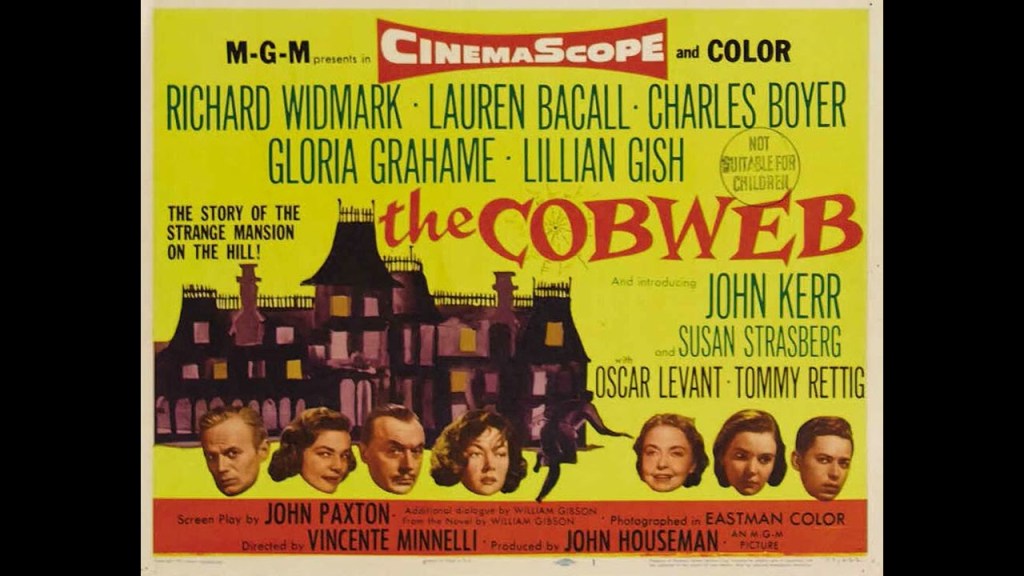
Ask people what genre they think film music is—is it classical? You will get widely varying responses. For some people, film music is a subgenre of classical music; for others, it is a completely separate genre that stands on its own. This June, the Daily Classical Music Post will look at the origins of film music and discover how it has evolved.
Main Title (The Cobweb soundtrack, 1955, Leonard Rosenman)
In the early 20th century, composers began to experiment with atonality, which Leonard B. Meyer described as the use of “ambiguous chords, improbable harmonic inflections, and more unusual melodic and rhythmic inflections than what was possible within the styles of tonal music.” The Austrian composer Arnold Schoenberg took this one step further, transforming 20th-century classical music with the development of his twelve-tone technique.
The American composer Leonard Rosenman (1924–2008) studied composition with Schoenberg. He also taught piano, and one of his students was the actor James Dean. This connection led to Elia Kazan hiring Rosenman to compose the film scores for East of Eden and Rebel Without A Cause, both released in 1955. In both of those scores, Rosenman experimented with atonality, the first composer to do so in film scores. However, it was his score for Vincent Minnelli’s The Cobweb, released between those two films, that was truly groundbreaking.
Ethan Iverson wrote, “Not too many classic Hollywood composers got a chance to consistently create on their own terms, and Rosenman would end up handling all sorts of styles when employed by the studios. However, Rosenman was a product and a devotee of midcentury atonal modernism, and modernism was how he made his mark in three scores from 1955. The music to East of Eden was ‘Americana’ cut with modernism while Rebel Without a Cause was ‘jazzy’ cut with modernism—but even more shocking was The Cobweb, the first Hollywood movie with a 12-tone score somewhat in the manner of Arnold Schoenberg.”
Jeff Bond and Lukas Kendall wrote in a review of The Cobweb score, “Rosenman’s avant garde writing accompanies a Vincent Minnelli/John Houseman film about a mental institution—not a horror film, but a character drama where the problems of the patients are dwarfed by those of the staff. Rosenman’s symphonic score evokes the inner neuroses of the characters with chamber-like colors and atonal counterpoint.”
Rosenman, who was open about the fact that composing for films would give him enough money to continue composing concert music, found it difficult to get his non-film music performed; he said, “The minute I did East of Eden I didn’t have any performances in New York for 20 years! That’s because suddenly I was a ‘film composer’.” He was championed by Charles Wuorinen, who included some of Rosenman’s chamber music in New York new music concerts. In an interview, Rosenman said, “Unfortunately, in America we have the opinion that if a composer works in film, he can’t write good music. This isn’t true in other countries. I’m a better composer now than I was before I started film scoring, yet before I started in films I had less trouble from the critics than I do now.”
My classical music post for today is Leonard Rosenman’s The Cobweb: Main Title.


Leave a Reply