

Ask people what genre they think film music is—is it classical? You will get widely varying responses. For some people, film music is a subgenre of classical music; for others, it is a completely separate genre that stands on its own. This June, the Daily Classical Music Post will look at the origins of film music and discover how it has evolved.
Entr’acte (1924) | Direção: René Clair; Trilha Sonora: Erik Satie
The first motion pictures were silent; well, except for the sound of the projector, which could be quite loud. Early filmmakers recognized that it would be nice to have some music to cover up that noise. The first films were presented in vaudeville theatres or similar spaces, so it was easy to ask the musicians already employed there to play along. Some musicians, mostly pianists, played anything already in their repertoire, while others improvised as they watched what was unfolding on the screen.
Most film music historians agree that the first composer to write what was the first frame-by-frame synchronous film score was the French composer Erik Satie (1866–1925), for René Clair’s avant-garde Dada film Entr’acte (1924). Martin Marks wrote, “This is the first complete original score we have by a leading avant-garde composer; and although it is Satie’s only film score, composed for a picture lasting a scant twenty minutes, it has been highly praised and even termed a model of film music. . . . The film’s unconventional nature forced Satie (or rather, reinforced his customary desire) to compose unconventional music.”
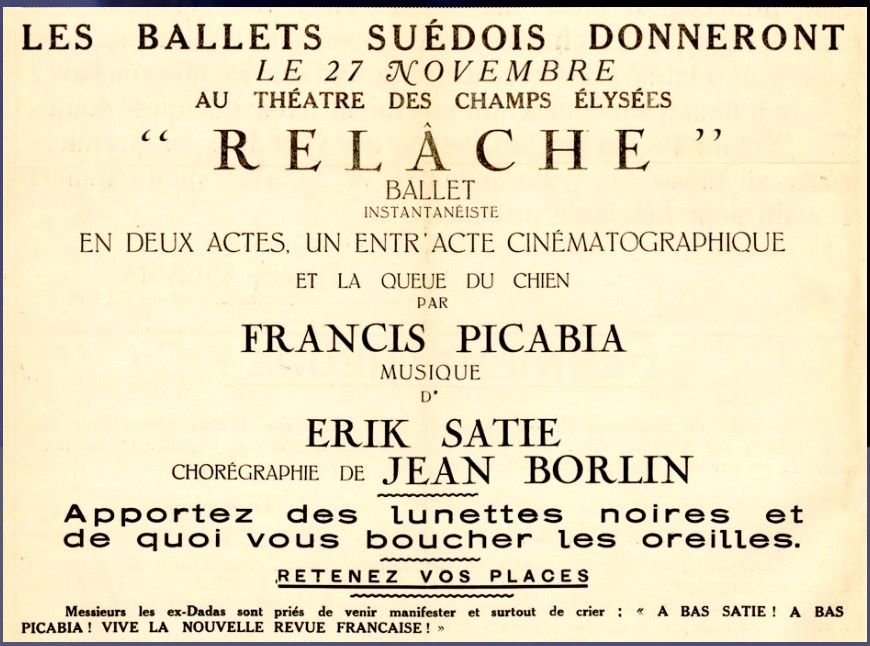
Entr’acte was originally presented between the two acts of the ballet Relâche, for which Satie also composed the music. The premiere of the ballet and the film was meant to be a kind of joke (the title of the ballet means “no show tonight”). Satie thought—or perhaps hoped—that the ballet would cause some kind of riot, but in the end no one was all that moved by the ballet. It was a different story about the film, however. The film has been shown often since its premiere, and the music has been seen as the beginning of a new relationship between film and music. Ian Gardiner wrote, “Although many celebrated figures of the contemporary Parisian avant-garde participated in its creation—as scenarists, designers, ‘actors’, guest appearances—primarily Entr’acte is a collaboration between a film-maker and a composer, one of the first great music and film collaborations in cinema.”
My classical music post for today is Erik Satie’s Entr’acte.


Leave a Reply