

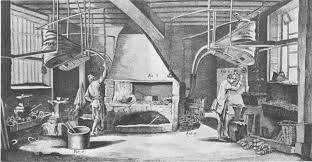
The first day of May is International Workers’ Day. Workers and the labour movements are celebrated worldwide on this day. This May, the Daily Classical Music Post will honour and commemorate the struggles, achievements, rights, and gains of workers through music.
Handel: Suite No. 5 in E Major, HWV 430 (Set 1) : IV. Air with 5 Variations “The Harmonious…
No one is quite sure why the fourth movement of the harpsichord Suite No. 5, HWV 430 (1720) by the German composer George Frideric Handel (1685–1759) is called “The Harmonious Blacksmith.” Handel didn’t name it; the name doesn’t appear anywhere until some time in the 19th century. Various stories have been floated, including one in which Handel heard a blacksmith singing the tune when he took shelter in the smithy during a rainstorm. Another says that there was a blacksmith named William Powell who had the nickname of the Harmonious Blacksmith; the claim was that Powell was Parish Clerk of a church in Whitchurch when Handel was the organist there. That one is a real stretch, mostly because Handel published the harpsichord suite long before Powell was at that church.
William Chappell wrote in the first edition of Grove’s Dictionary of Music and Musicians, “The original publisher of Handel’s lesson under that name (The Harmonious Blacksmith) was a music seller at Bath, named Lintern, whom he knew personally from buying music at the shop, that he had asked Lintern the reason for this new name, and he had told him that it was a nickname given to himself because, he had been brought up as a blacksmith, although he had afterwards turned to music, and that was the piece he was constantly asked to play. He printed the movement in a detached form, because he could sell a sufficient number of copies to make a profit.”
Whatever the reasons, this virtuosic, lively air and five variations has been enjoyed by performers and audiences in its original version for harpsichord as well as in arrangements for piano, guitar, and ensembles. The repeated pedal note in the first variation is reminiscent of a blacksmith hammering on an anvil. Other composers used the theme in their own compositions, including Mauro Giulani, Louis Spohr, Francis Poulenc, and Percy Grainger. It was well known enough that Charles Dickens referred to it in Great Expectations; Pip was nicknamed “Handel” because he was brought up as a blacksmith, and Herbert Pocket said, “We are so harmonious—and you have been a blacksmith.”
My classical music post for today is George Frideric Handel’s Suite No. 5 in E Major, IV. “The Harmonious Blacksmith.”


Leave a Reply