

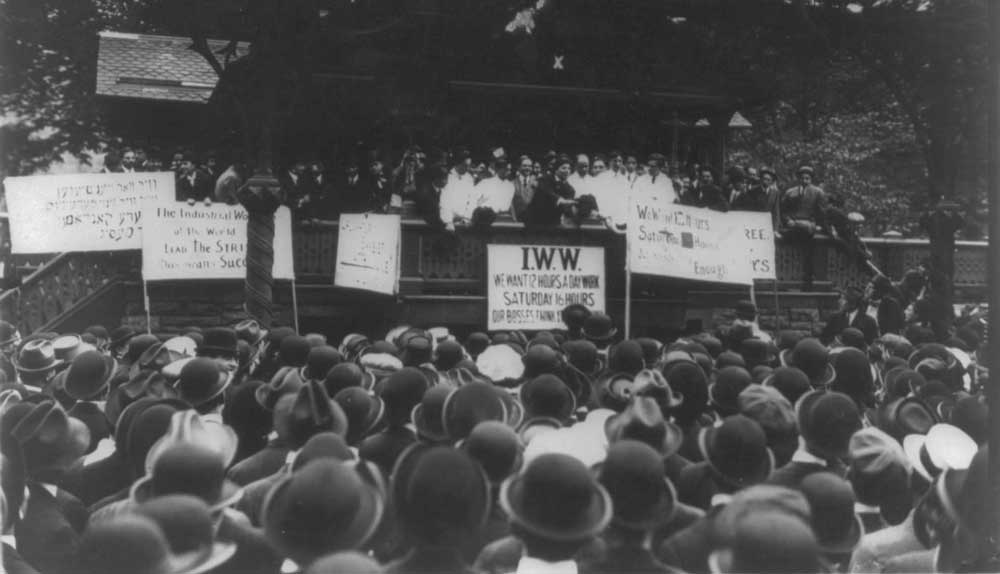
The first day of May is International Workers’ Day. Workers and the labour movements are celebrated worldwide on this day. This May, the Daily Classical Music Post will honour and commemorate the struggles, achievements, rights, and gains of workers through music.
Joe Hill was born Joel Hägglund in Sweden in 1879. He emigrated to the United States in 1902. He became an itinerant labourer, moving from New York across the country, finally ending up on the west coast. He joined the Industrial Workers of the World (IWW), an international labour union founded in 1905, using the name Joe Hillstrom. He quickly rose in the ranks and as “Joe Hill” became well known for his political songs and satirical poems. In 1914, he was accused of murdering two men in a Salt Lake City, Utah, grocery store. Because he was a “Wobbly” (the nickname given to members of the IWW), the prosecution at his trial insisted that he must have committed the crime, even though there was no evidence. However, Hill was convicted and executed in 1915. Hill’s final words, sent in a telegram to the labour organizer Bill Haywood, were “Don’t waste any time mourning. Organize.” Gibbs H. Smith said that Hill “came to symbolize the struggle of the working people against this oligarchy of capitalists.”
The American composer Earl Robinson (1910–1991) set a poem by Alfred Hayes about Joe Hill in 1936. Robinson was a member of the Communist Party, and his most well-known music expressed his political views and support of the labour movement, which led to his being blacklisted in the 1950s. The text of the poem tells of a dream that someone had in which Joe Hill claims that he never died at all; he says that he was framed for murder and shot by the “Copper Bosses.” The penultimate verse delivers the main message: “From San Diego up to Maine, / in every mine and mill, / Where workers strike and organize / it’s there you’ll find Joe Hill, / it’s there you’ll find Joe Hill!”
Miriam Lewin wrote, “More famous than Joe Hill’s own songs, though, is a song that was written about him. Ten years after he died, Alfred Hayes wrote a poem called ‘I Dreamed I Saw Joe Hill Last Night.’ Earl Robinson set it to music about a decade later, and it quickly became an anthem for the labor movement. Starting in the 1930s, the African-American actor and singer Paul Robeson was one of this country’s most passionate voices for the outsider. He lent his voice to the struggles of blacks, workers, and anyone who had trouble getting a fair deal. Paul Robeson sang ‘I Dreamed I Saw Joe Hill Last Night’ all over the world, at rallies and protests—and in concert.”
My classical music post for today is Earl Robinson’s “I Dreamed I Saw Joe Hill Last Night.”


Leave a Reply