

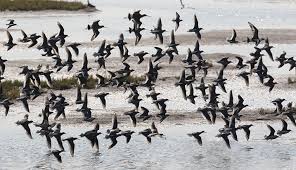
A is for April, and it’s also for Animals! This April, the Daily Classical Music Post explores music celebrating the animal kingdom.
Ouverture The Birds (De Vogels)
“It was incomprehensible to me that there could be a world without birdsong.”—Terry Tempest Williams
The Dutch composer Alphons Diepenbrock (1862–1921) didn’t intend to be a musician; in fact, he never had any formal training. He studied classics and became a teacher. He was in his early 30s when he turned to composition. Most of his output is vocal. He created his own musical language that combined 16th-century polyphony with Wagnerian chromaticism. His later works show the influence of Claude Debussy’s impressionistic techniques. Leo Samama said, “The lack of a formal musical education, for example, was precisely what led him to write the music that he wrote, and was the reason why he ‘scraped and sighed’ as he did. A survey of Diepenbrock’s correspondence suggests that his music was born from a kind of spontaneous inspiration, which then needed to be conquered through toil and persistence, before arriving at a score that represented the sound he had envisaged.”
In 1917, Diepenbrock composed incidental music for a Dutch-language staging of Aristophanes’ The Birds. He published this in a three-section score: Overture for orchestra; Invocation for tenor solo and orchestra; and Ballets for speaker, women’s chorus, and orchestra. Rob Barnett called Diepenbrock’s orchestral music “extravagantly brooding,” and said, “The overture De Vogels (The Birds) is a fairly blithe Straussian piece with an exuberant whoop yet by no means densely orchestrated. Much of the piece is quiet, delicate, fluttering and chirruping with birdsong—some of it luxuriously diaphanous and redolent of Ravel’s Daphnis on the one hand and Bax’s Spring Fire on the other.”
My classical music post for today is Alphons Diepenbrock’s De Vogels: Overture.


Leave a Reply