

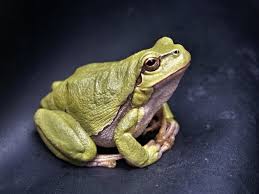
A is for April, and it’s also for Animals! This April, the Daily Classical Music Post explores music celebrating the animal kingdom.
Anne LeBaron – Concerto For Active Frogs
“Eat a live frog first thing in the morning and nothing worse will happen to you the rest of the day.”—Mark Twain
The American composer Anne LeBaron (born 1953) combines tonal and atonal techniques with elements of blues, jazz, pop, rock, and folk music. Her music is experimental and often incorporates electronic enhancements and extended techniques, particularly for the harp, which is her main instrument. Her primary composition teachers were Chou Wen-chung and Mario Davidovsky. She has won many awards, fellowships, and grants.
Concerto for Active Frogs was composed in 1974 for baritone soloist, mixed chorus, and percussion plus two other instruments. The graphic score includes the following instructions for the musicians: “Chorus members and solo vocalist should wear a dark green plastic garbage bag over their clothes, with holes cut for head and arms; instrumentalists should also wear the bags, unless they interfere with performance. Performers may also wear frog face masks, and additional costumes are encouraged within the context of the frogs, so long as they do not inhibit playing. Any other extramusical additions may be made at the discretion of the performers, and may be pre-planned or spontaneous.”
LeBaron said in the programme notes, “The frogs represented in Concerto for Active Frogs are found throughout the U.S. and Mexico and were extracted from the Folkways recording entitled Sounds of North American Frogs and assembled into a tape collage. Frogs have lived on this earth for around 200 million years; quite possibly, the first voice in existence was that of a frog. With one exception, all vocalizations are produced with the mouth and nostrils closed. Smaller species with high-pitched voices possess external vocal pouches that balloon out as resonators, whereas the larger species have proportionally smaller vocal sacs. In the very large frogs, there is often no external vocal sac, and the throat merely assumes a swollen appearance during calls. . . . Sounds other than mating calls fall into five categories: warning vocalizations, warning sounds, rain calls, screams, and territoriality calls. Warning chirps and croaks are some of the more striking sounds chosen for the tape collage in the Concerto. . . . This work was conceived as a showcase for the frogs. The chorus of humans and the instrumentalists react individually to the frogs, creating various ‘conversations’ in the process. The Concerto is designed to open, or at least widen, a channel of awareness and respect for the inherent musicality of these ancient tailless amphibians.”
My classical music post for today is Anne LeBaron’s Concerto for Active Frogs.


Leave a Reply