

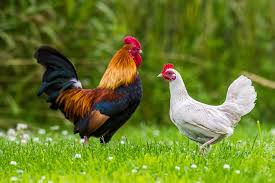
A is for April, and it’s also for Animals! This April, the Daily Classical Music Post explores music celebrating the animal kingdom.
“It may be the rooster that does all the crowing but it’s the hen that delivers the goods.”—Jim Hightower
The Italian Baroque composer Carlo Farina (ca. 1600–1639) studied music with Salomone Rossi, Giovanni Battista Buonamente, and Heinrich Schütz; the latter fostered Farina’s interest in composing. Farina was one of the first violin virtuosos and he used this talent in his writing for the violin in many works, including the Capriccio Stravagante (1627), which is considered to be his masterpiece. Most of his other compositions, mainly for violin, are virtually unknown. Lindsay Kemp said, “Carlo Farina was among the first composers to write specifically for the violin, playing a major part as he did so in developing such techniques as double-stopping, tremolo and col legno.”
Martin Pearlman said, “The Capriccio stravagante, a humorous chamber piece for string instruments published in Dresden in 1627, is one of the most avant-garde works from a very experimental time in music history. Not only does it call for new effects on the violin—glissando, pizzicato, sul ponticello (bowing close to the bridge), col legno (playing with the wood of the bow), tremolo—some of them for the first time, but it is also full of musical jokes, imitating the clucking of a hen, the crowing of a rooster, an organist getting lost in his improvisation, the meowing and fighting of cats, the barking of a dog, and a closing section that ends in no particular key but simply slows down, gets softer, and fades away.”
Andrew Bonner said, “Capriccio Stravagante uses four violin-family instruments (violin, two violas, and a violoncello-range instrument) to mimic other instruments such as trumpets, shawms, organs, and guitars. . . . Carlo Farina and the Capriccio model the influence of emerging tastes for Italian practices and musicians in the courts of northern Europe, and for the violin as an individually idiomatic solo instrument.”
Daniel Walden said, “In ‘Die Henne’ [‘The Hen’] and ‘Der Han’ [‘The Rooster’] [Note: in some scores, called ‘La Gallina’ and ‘Il Gallo’] Farina uses many of the same patterns that served to indicate the military band, but this time to depict hens and roosters. The descriptive titles framing the beginning of each episode in the work help the performer to recognize that sometimes the musical gesture has only been slightly modified, while the subject depicted has changed (as here, from the band instruments to the barnyard animals). Clearly, there is a joke here: he demonstrates how easily the sound of a marching army can be transformed into the procession of poultry in a barnyard.”
My classical music post for today is Carlo Farina’s Capriccio Stravagante.


Leave a Reply