

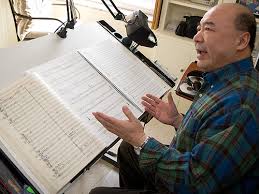
There has always been a cultural exchange between the arbitrarily divided regions labelled East and West. However, the overwhelming influence of European and U.S. art and folk music often obliterated the traditional classical music in Asia. This March, the Daily Classical Music Post explores music by Asian composers who have sought to redress the balance.
The Chinese-American composer Zhou Long (born 1953) began studying piano when he was a young child. The Cultural Revolution interrupted those studies. He has said that his time on a farm driving a tractor, observing and experiencing the desolate landscape, wind, and fire made a profound impression on him, and he has aimed to include those feelings in his music throughout his career.
After the end of the Cultural Revolution, he was one of only 100 students chosen from over 18,000 to attend the Central Conservatory of Music in Beijing. He studied composition there as well as music theory, conducting, and traditional Chinese music. In the 1980s, Zhou was awarded a fellowship to study in New York. He was music director of the cultural organization Music From China in the 1990s. He became a citizen of the United States in 1999. He and his wife Chen Yi (we heard some of her music earlier this month) were made Honorary Members of the Society for American Music in 2018.
Zhou won the Pulitzer Prize for Music in 2011 for his opera Madame White Snake. Like all of his music, this opera combines Western music techniques and soundscapes with traditional Chinese music. He said, “Thinking about what we could do to share different cultures in our new society, I have been composing music seriously to achieve my goal of improving the understanding between peoples from various backgrounds. My conceptions have often come from ancient Chinese poetry. . . . Verses of poetry may give you the frame; the movements of calligraphy may give you the rhythm; an ancient dark ink painting may give you space, distance and layers; a variety of sound sources may give you the color. Finally, craft ensures your own full expression.”
Zhou’s Words of the Sun, for tenor solo and unaccompanied SATB choir, was composed in 1982 and was revised in 1997. The text by Ai Qing was translated by the composer. The words are set to a folksong-like melody that evokes a sense of early morning, sunrise, and gentle breezes. This is a stunningly beautiful choral work filled with hope: the sun will rise and a new day will dawn.
My classical music post for today is Zhou Long’s Words of the Sun.


Leave a Reply