

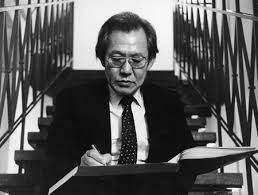
There has always been a cultural exchange between the arbitrarily divided regions labelled East and West. However, the overwhelming influence of European and U.S. art and folk music often obliterated the traditional classical music in Asia. This March, the Daily Classical Music Post explores music by Asian composers who have sought to redress the balance.
The Korean composer Isang Yun (1917–1995) began his musical studies at the age of 13. He wanted to become a professional musician but his father, a poet, objected. He relented after Yun agreed to study business as well as music. He moved to Japan to study music but returned to Korea in 1941. He was arrested in 1943 for his participation in the Korean Independence Movement. After World War II and the subsequent Korean War, he travelled to Paris, where he continued his studies. He then moved to Germany in the late 1950s, where he eventually settled.
Yun focused on the fusion of traditional Korean music and Western avant-garde musical techniques. He experimented with 12-tone music, which led to the development of his own musical personality. Elements of traditional Korean music that can be heard in his music include glissandi, pizzicati, portamenti, vibrati, and elaborate ornamentation. His works utilize multiple-melodic lines, which he called “Haupttöne.”
Sue-Hye Kim said of Yun’s Réak für Orchester (1966), “In Réak, Isang Yun created a Korean ambiance through the symbolic use of Korean traditional music—notably that of ancient ceremonies based on Chinese models. The title Réak connotes solemn ritual music; although it does not literally imitate Korean ritual music, it nevertheless imparts a ritualistic characteristic that evokes the mood of Korean court music.”
Réak opens with an evocation of Korean ceremonial music beginning with percussion. The second movement contains a highly ornamented melody that is passed between instruments, and the low strings imitate a traditional Korean instrument, the gayageum. The third movement is a dense sound layer that washes over the listener. The final movement contains elements of all of the previous sections. This intriguing work, a fascinating combination of traditional Korean ceremonial music and modern Western musical compositional techniques, solidified Yun’s international reputation.
My classical music post for today is Isang Yun’s Réak für Orchester.


Leave a Reply