

There has always been a cultural exchange between the arbitrarily divided regions labelled East and West. However, the overwhelming influence of European and U.S. art and folk music often obliterated the traditional classical music in Asia. This March, the Daily Classical Music Post explores music by Asian composers who have sought to redress the balance.
Sandeep Bhagwati: “PRANA-Music of Breaths” (2024) Montréal
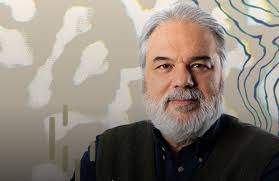
The Indian-German composer Sandeep Bhagwati (born 1963) grew up in Germany in a household filled with music, but he didn’t begin to explore his own relationship with music until he was 16 years old. He has won multiple awards for his compositions, which include operas, installations, computer music, and much more.
He once wrote that when he decided that he wanted to become a composer, his father hoped that his compositions would integrate “Western and Indian musical influences into something new.” For several years, he fought against this, wanting instead to be considered a “German” composer. It wasn’t until he was 30 that he realized he had been subconsciously including Indian rhythms and other concepts of Indian classical music in his own works.
Bhagwati coined the term “eurological” for the forms of music that are consciously set in the European mind-set, wherever they are practiced in the world. He has often spoken of the indigenous music that was lost around the world as a result of European colonization, some of which was recorded by 19th-century ethnomusicologists and then consigned to dusty basements and archives. He said, “I cannot be an expert on ‘Indian orchestra music’—because such experts cannot exist. India has its own classical music system which does not deal in works for orchestra. In Indian musical life, the presence of eurological art music is as marginal as that of Balinese music in Germany. The few composers with an Indian name who have written orchestral works did so for orchestras in Europe and North America. But these composers—and I count myself among them—cannot be classified as ‘authentically Indian,’ however one might wish to define the term. . . . all too often, such an emphasis on ‘the authentic’ is a clear indicator for right-wing sympathies.”
Bhagwati described his “PRANA—Music of Breaths,” in nine movements written for four trombones and four voices, as a comprovisation score (a mix of predetermined structures with improvised sections). This installation piece takes as its starting point the idea that breath is the only measure of time in music. The musicians in this piece are instructed to complete one task in one single breath before going on to the next musical task and the next breath. “PRANA” was composed in 2020 and “Music of Breaths” was composed in 2022. He then combined the two pieces in 2024, leading the audience into a new way to think about how people breathe and listen.
My classical music post for today is Sandeep Bhagwati’s “PRANA—Music of Breaths.”


Leave a Reply