

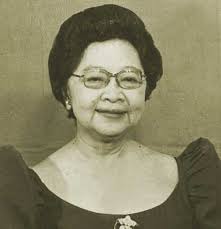
There has always been a cultural exchange between the arbitrarily divided regions labelled East and West. However, the overwhelming influence of European and U.S. art and folk music often obliterated the traditional classical music in Asia. This March, the Daily Classical Music Post explores music by Asian composers who have sought to redress the balance.
Lucrecia Kasilag – Ang Basura (1998)
The Filipino composer Lucrecia Kasilag (1918–2008), known as “King,” studied piano in Manila before turning to composition towards the end of World War II. Her works are a fascinating fusion of indigenous Filipino instruments and styles and Western orchestral forms. She was also known as “The First Lady of Philippine Music.”
James Carl Langman Osario said, “As the Philippines’ first contemporary woman composer, she responds to the many currents of modern music. Among these trends are impressionism and expressionism, primitivism, neoclassicism, neo-romanticism, jazz, polytonality, avant-garde and electronic music. If we put this in the perspective of the Philippines in the 1950s, Kasilag’s eclectic style had the innuendos of nationalism that figuratively strives to disperse the smoke of colonialism while also acknowledging the unchangeable facts and consequences of history. . . . Kasilag’s hybridity validates the claim of Filipinos on Western music, not as an immutable universal product, but rather as a birthright.”
Kasilag’s wonderful and unusual chamber work Ang Basura (1998) was composed for voice, guitar, kulintang, and dabakan. The composer described the piece as a rap. It was the first time that she combined contemporary popular music with her own classical style. Ang Basura is in two parts: Maraming Basura (lyrics by Roy Alvarez) and Ang Basura, Bow (lyrics by Odette Alcantara). Both parts were composed for Mother Earth, and received their premiere on 30 December 2000.
The website Ateneo Blue Sound describes Ang Basura: “The musical style, despite being a rap, is distinct to the style of Kasilag. It has a very traditional Filipino sound to it, and unlike most hip-hop genre raps, it is very slow paced so that it is easy to listen to and understand the lyrics. This helps get the message across while being able to maintain an oriental sound to it. In addition, it was Kasilag who originally raps this piece, which she did at the age of 81. . . . Ang Basura is a very daring piece done by Kasilag, in order to send a message, that the main problem is not the garbage on the street or in the river, but the garbage in our thoughts, or ‘ang basura sa isip’. The problem is not the litter around us, but the people that cause the litter. That is what this song tries to get across, and that is what it does through an interesting and catchy rhythm. While this song is not the most popular of Kasilag’s pieces, it should not be set aside either, as this is one that holds a very important meaning.”
My classical music post for today is Lucrecia Kasilag’s Ang Basura.


Leave a Reply