

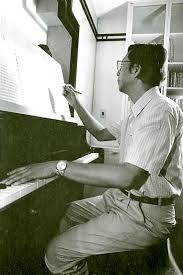
There has always been a cultural exchange between the arbitrarily divided regions labelled East and West. However, the overwhelming influence of European and U.S. art and folk music often obliterated the traditional classical music in Asia. This March, the Daily Classical Music Post explores music by Asian composers who have sought to redress the balance.
[Ma Shui-Long] Taiwan Suite for Piano (Score-Video)
The Taiwanese composer Ma Shui-long (1939–2015) was largely self-taught. He was particularly well known for blending Western instrumentation with pentatonic melodies typical in Asian music. Much of his music was inspired by his memories of the mountain town where he grew up. Ma studied in Taiwan and Germany, and in 1986 he received a Fulbright award to perform his music and study at the Lincoln Center in New York. He was the first Taiwanese composer to have his work performed there. Bernard Holland said that Ma let his instruments “speak in a European voice but with an Asian mind.”
Curtis Pavey said, “Hsun-Yin Chang describes Ma’s output in three stages. Ma’s earliest compositions feature heavy use of Taiwanese folk material and influence of Eastern compositional elements. In his middle period, Ma’s works became more avant-garde, featuring significant dissonance and an improvisational style. Ma’s final compositional period includes music that combines both Western and Eastern compositional elements, styles, and materials. Ma’s compositional philosophy became a central focus in his teaching as he developed college courses to help students embrace Chinese and Taiwanese musical elements in deep, significant ways.”
Ma composed his Suite Taiwan for piano in 1966. This four-movement work is filled with his memories of Taiwanese rituals and traditional music, as can be seen in the titles of each movement: The Temple; Religious Procession; Lion Dance; and The Lantern Festival. Percussive techniques and pentatonic melodies are fused with Western pianistic writing in a unique and evocative way. Ma said that this work was to some extent an homage to the town where he was born.
Pi-Lin Ni said in an analysis of Suite Taiwan, “In the beginning of the first piece, Ma portrays the temple atmosphere by mimicking the sounds of Chinese blocks and Qing, used by the monks in their daily prayers. . . . One common feature found in all four pieces is the folksong-like quality. In almost every piece there is at least one section featuring a folksong-like melodic theme, and a Chinese flavor permeates the entire piano suite.”
My classical music post for today is Ma Shui-long’s Suite Taiwan.


Leave a Reply