

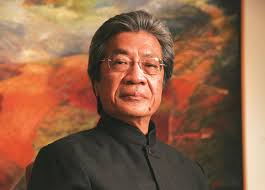
There has always been a cultural exchange between the arbitrarily divided regions labelled East and West. However, the overwhelming influence of European and U.S. art and folk music often obliterated the traditional classical music in Asia. This March, the Daily Classical Music Post explores music by Asian composers who have sought to redress the balance.
The Cambodian-American composer Chinary Ung (born 1942) spent his childhood in a Cambodian village, where the sounds of Khmer folk music and instruments ignited his passion for music. He moved with his family to Phnom Penh when he was 18, and he was accepted into the first class of L’Ecole Nationale de Musique (later the Royal University of Fine Arts), which had just opened. This European-style conservatory introduced him to a whole new world of music, and he began his study of the clarinet.
It was the clarinet that would take him to the United States of America in 1963, on a grant from the Asia Foundation. The grant was nearly cancelled by Prince Sihanouk’s accusations of U.S. military strikes in northern Cambodia, but at the last minute Ung was allowed to travel, grant intact. He studied clarinet at the Manhattan School of Music in New York, and he was introduced to Western classical music, which had a profound affect on him. When the Asia Foundation grant ran out, he received a different grant, and although he returned to Cambodia for one month in 1968, he was not to return for 34 years.
Adam Greene said, “The rise of the Khmer Rouge and its policies confirmed Ung’s fears regarding the threat to music and culture in Cambodia, as the practice of music was banned in the country and musicians were either killed or sent to forced labor camps. . . . Ung was able to compartmentalize the agony of personal loss into a project of preservation, and ultimately, of hope. To have agency in the midst of calamity was a privilege. Over the next several years he would make contributions to the preservation of Cambodian culture through three, often interrelated, roles: Archivist, Teacher, and Performer.”
Ung studied composition in New York with the Chinese-American composer Chou Wen-chung, and Chou helped him to understand how to combine finding his own personal voice in composition with his sense of responsibility towards his roots. In addition to re-discovering the Khmer music of his childhood and incorporating that into his compositions, Ung’s music also shows the influence of Indian, Japanese, Chinese, and Indonesian music. He doesn’t quote folk music; listeners get more of an impression.
Greene said, “Ung’s view of musical time reveals his sympathy for Asian aesthetics even more than does his treatment of pitch and instrumental color. In Western classical music, time governs all. . . . Ung’s music is largely un-metered—although note values are given, there is an inherent flexibility ascribed to the temporal domain. . . . In Ung’s music, one rarely encounters an orderly succession of events that corresponds to the Western tradition of musical time. Rather, one often experiences suspension and silence.”
Inner Voices, composed by Ung in 1986 to a commission by the Pennsylvania Arts Council for the Philadelphia Orchestra, is dedicated to his teacher Chou Wen-chung. This 20-minute long work for orchestra fuses Cambodian folk melodies with Western composition techniques. Ung won the Grawemeyer Award for Musical Composition in 1989 for this piece. In his programme notes for a performance of Inner Voices in 1990, Ung said that the work begins with an image in his memory from childhood of “an old woman who collected scraps of cloth, all shapes and colors. . . . Each time we went to her hut, I watched the progress as she overlapped and sewed them together into a quilt.”
My classical music post for today is Chinary Ung’s Inner Voices.


Leave a Reply