

William Cosgrove famously said, “Music hath charms to soothe a savage breast.” At this pivotal moment in the world’s history, the Daily Classical Music Post explores music by composers who ran afoul of tyrants and dictators and who as a result were banned, imprisoned, or executed. We’ll also listen to some music by composers who criticized the regime under which they worked but managed to fool the ruler.
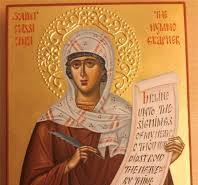
Kassia (or Kassianē) the Hymnographer (c. 810–c. 867) was a member of the nobility. She was meant to marry Emperor Theophilos, but her headstrong manner and forthrightness made him pass over her for another more suitable (i.e., more acquiescent) wife. Kassia went on to found a convent in Constantinople, where she was abbess and wrote, taught, and composed.
Jenny Kaplan said, “Legend has it that the Emperor Theophilus, years later wishing to see Kassia one more time, went to the monastery but was met by her empty cell (she was actually hiding in the closet). When he saw the Hymn of Kassia on her table halfway finished, Theophilus added one line of his own, which Kassia chose to keep in his honor and remains in the hymn today. While Theophilus may have maintained an affection for Kassia, that didn’t stop him from persecuting her. Theophilus was a fierce iconoclast, which meant that he completely rejected the use or veneration of religious icons or iconography in the Byzantine church. Kassia, on the other hand, was a defender of the use of icons. For her perceived insolence, Kassia was whipped with a lash. Still, she refused to change her mind, saying ‘I hate silence, when it is time to speak’.”
Kassia is unique in that she is the only known woman whose music appears in the Byzantine liturgy. There are about 50 extant hymns that have been attributed to her, although it is possible that half of them were written by someone else. Another problem in attribution comes from the fact that the earliest surviving manuscripts of her works are dated centuries after her lifetime.
Kassia composed many hymns that are still sung today. The Hymn of Kassia, the most well known of these, is an extraordinary piece of music. This slow and plaintive work requires a wide range. It is incredibly demanding and can be sung by one voice or by many in unison over a Byzantine drone.
My classical music post for today is Kassia’s Hymn of Kassia.


Leave a Reply