

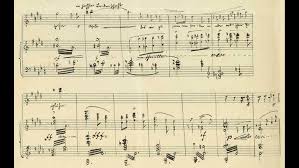
The first work of a classical composer can provide a glimpse of who that composer will become, or it can seem as if it was written by a totally different musician. This November, the Daily Classical Music Post will explore some first works (or Op. 1 works, not always the very first work) by composers familiar and unfamiliar.
Anton Webern: Two pieces for cello and piano (1899)
Austrian composer, conductor, and musicologist Anton Webern (1883–1945) is primarily known for his advancements in atonality. His musical legacy has influenced serialism in Western art music for much of his life and for decades following his death. Webern’s music is typically concise, often sparse in instrumentation, and quite linear in structure.
Anton Webern was the only surviving son of his parents and grew up with two sisters. His father Carl was a mining engineer and owned a copper mine; his mother Amalie was a pianist and singer, and taught Anton to play the piano when he was young. Anton also received cello lessons. In 1902 he began studying musicology at the University of Vienna under the tutelage of Guido Adler, having been to Bayreuth (Richard Wagner’s purpose-built opera house). His opus 1, Passacaglia for orchestra, was written in 1908, but was not published until 1922; it appears that his earliest published work is the Six Pieces for Orchestra, initially written in 1909, published in 1913, revised in 1928, and re-published posthumously in 1956.
But Webern was, in fact, composing for several years before beginning his studies in musicology. His earliest written work, unpublished until 1975 but written in 1899, is two short pieces for cello and piano. (And when I say “short,” I mean it—both pieces combined last under 5 minutes!) Written entirely tonally, in a late-Romantic era style that reminds me somewhat of the Brahms cello sonatas, these two nuggets are stylistically incredibly different to what many of us think of when we hear the name Webern. What’s interesting, though, is that within that framework, the bones of what he would become later in his compositional career are already evident—the conciseness of the writing and particularly the hyper-expressionism. Although many performers, both during Webern’s life and after his death, have tended to focus on the more literal formalistic aspects of his music, thus rendering it inaccessible to many audiences, more recent scholars have begun to uncover a broader understanding of Webern’s artistic approach. To wit: Webern intended for his work to be deeply expressive. In my opinion, his technical advancements into atonality contrast with his almost nostalgic prioritization of expressivity and emotion. This work, then, is in some ways a musical thesis statement; although his later compositions become increasingly more abstract in terms of tonal language and texture, there is a throughline of expression that can be traced once we know where he began as a composer.
My classical music post for today is Anton Webern’s Two pieces for cello and piano.


Leave a Reply