

The first work of a classical composer can provide a glimpse of who that composer will become, or it can seem as if it was written by a totally different musician. This November, the Daily Classical Music Post will explore some first works (or Op. 1 works, not always the very first work) by composers familiar and unfamiliar.
The Italian composer Vittoria Aleotti (c. 1575–after 1620) is very possibly the same person as Raffaella Aleotta (c. 1570–after 1646). Madison Anthony said, “There is uncertainty surrounding the connection between the names Raffaella and Vittoria: were they the same person, or were they siblings? The current consensus with most music historians is that Vittoria Aleotti changed her name to Raffaella when she took her vows to become a nun, but it has not been proven that they are the same person.”
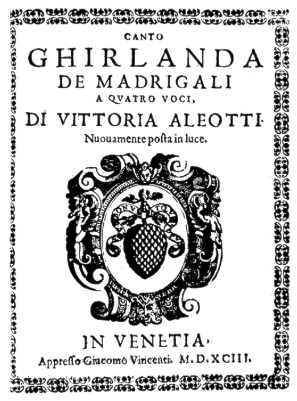
Aleotti was fascinated with music from a very young age, and her father encouraged her study of performing and composition. She even had one madrigal published in an anthology before she entered a convent at the age of 14. A few years after that, her father gave her a set of madrigal texts, and she set them to music. Anthony said, “[Her father] gave the results to Count del Zaffo, who had the music printed by Vincenti in Venice, as Ghirlanda de madrigali a quattro voci, in 1593.” Ghirlanda de madrigali a quattro voci is very likely the first collection of madrigals to be published by a woman.
It was quite an achievement at that time for a woman to have an entire volume—in this case, 18 madrigals—devoted to her own compositions. Thomasin LaMay notes that Aleotti may have found composing music to traditional text about love from the point of view of a man challenging, but her word painting is spot on. One of the madrigals from Ghirlanda de madrigali a quattro voci, “Io V’amo Vita Mia,” shows Aleotti’s crafty use of dissonance to express emotions. By employing accidentals and melismas, this composer revealed her own unique voice.
My classical music post for today is Vittoria Aleotti’s “Io V’amo Vita Mia.”


Leave a Reply