

The first work of a classical composer can provide a glimpse of who that composer will become, or it can seem as if it was written by a totally different musician. This November, the Daily Classical Music Post will explore some first works (or Op. 1 works, not always the very first work) by composers familiar and unfamiliar.
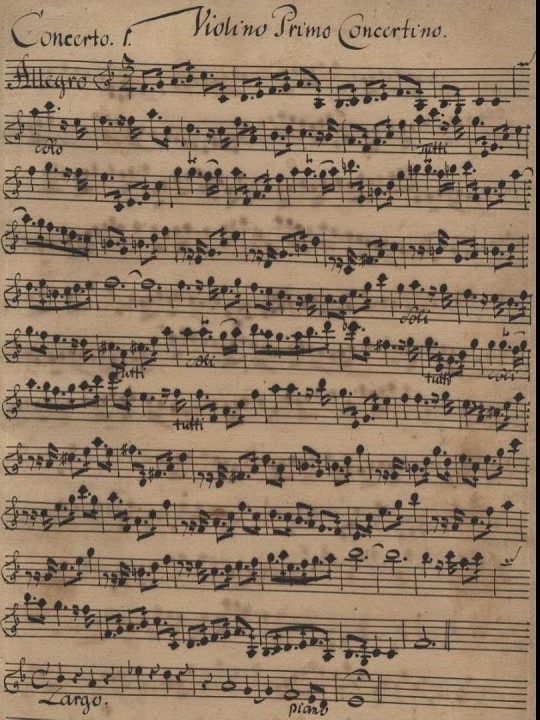
Locatelli: Concerto grosso in D Major, Op. 1 No. 9 – I. Allegro
The Italian Baroque composer Pietro Locatelli (1695–1764) was famous as a violinist throughout Italy and Germany. His compositions mostly date from the 1720s, when he travelled to cities in both of those countries and performed his works in concert. Locatelli apparently was so concerned that other composers would steal ideas from him that he would only allow music lovers, not professional musicians, into his concerts. He became fairly rich as a result of the support that he received from wealthy patrons, some of whom were amateur musicians. There is a period of about 20 years, from the mid-1740s to the early 1760s, when nothing is known of him at all.
Locatelli’s XII Concerti grossi, Op. 1, were published in 1721, and like his later works was published in Amsterdam. He modelled the XII Concerti grossi on Arcangelo Corelli’s Twelve concerti grossi, Op. 6 (although the textures are more reminiscent of Francesco Geminiani’s music). Peter Holman said, “Locatelli is traditionally thought of as ‘the Paganini of the eighteenth century’, largely because L’Arte del Violino contains twenty-four virtuoso unaccompanied caprices (ostensibly serving as cadenzas to the concertos) that have a superficial resemblance to Paganini’s unaccompanied caprices. L’Arte del Violino undoubtedly contains some of the most difficult violin music written in the eighteenth century, and listeners who have been attracted to Locatelli by its pyrotechnics will be surprised and perhaps initially disappointed by Op 1. . . . Locatelli still largely retains the archaic structure of seventeenth-century instrumental music. All the concertos but one are in a minimum of four movements, and several of them use Corelli’s multi-sectional design with short contrasted passages sewn together like a patchwork quilt.”
Holman notes that although Locatelli’s Op. 1 was very successful on the Continent, for some reason these 12 concertos never became popular in England. This may have been in part because the 18th-century music writer Charles Burney was not impressed by Locatelli, saying that his music “excites more surprise than pleasure” while the 18th-century English composer Charles Avison said that Locatelli’s compositions were “defective in various harmony and true invention.” This seems pretty harsh, particularly as the concertos in Op. 1 are actually quite fascinating; as a review of a recording said, “Locatelli’s textures are never simple; there is always a lot going on in his music. You sense in these concertos a young composer whose mind was positively bursting with ideas—and perhaps didn’t yet have the discrimination always to use them effectively, still less economically. It is very inspiring music, but also a shade exhausting because of its eventfulness, elaboration and density.”
My classical music post for today is Pietro Locatelli’s Concerto grosso in D Major, Op. 1 No. 9: I. Allegro.


Leave a Reply