

The first work of a classical composer can provide a glimpse of who that composer will become, or it can seem as if it was written by a totally different musician. This November, the Daily Classical Music Post will explore some first works (or Op. 1 works, not always the very first work) by composers familiar and unfamiliar.
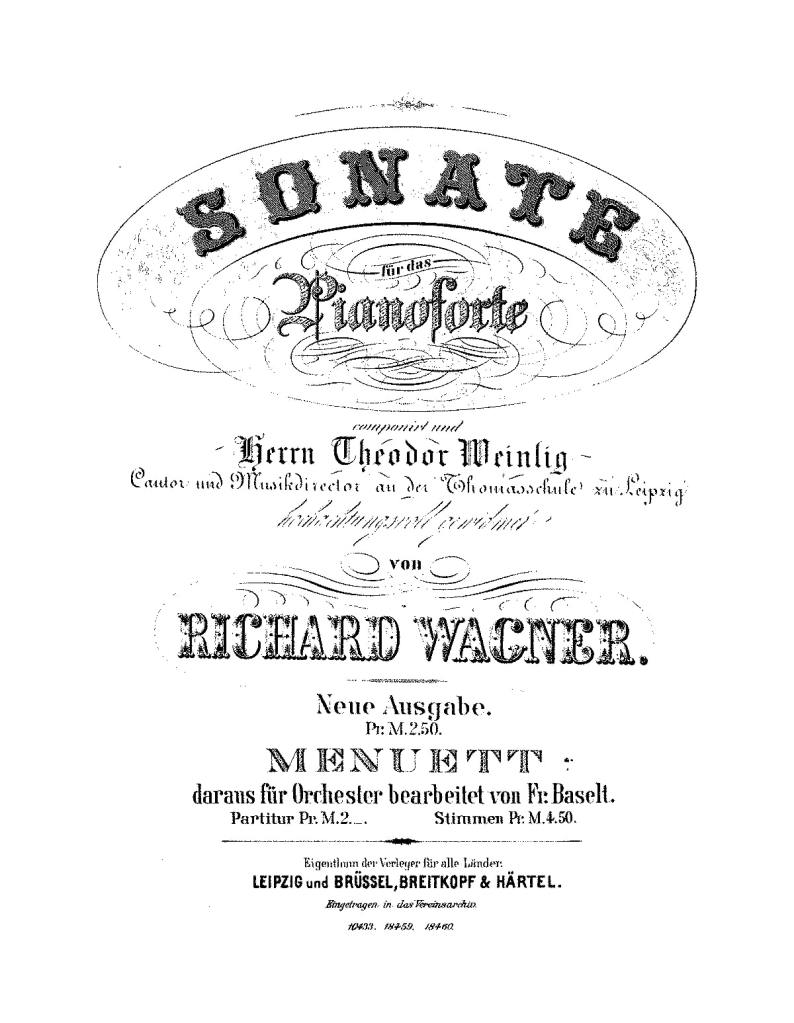
Richard Wagner – Piano Sonata in B-flat, Op. 1, WWV 21 (1831) [Score-Video]
The first thing that comes to mind when hearing the name of the German composer Richard Wagner (1813–1883) is opera, and most specifically the Ring Cycle. However, Wagner composed a lot more than just opera; his output includes orchestral works, piano works and songs, and some chamber works as well. And as with many of the other composers we’ve looked at this month, Wagner’s Op. 1 is a work for piano, the Sonata in B-flat (1831). Composed when he was 18 years old, this work reveals a little of the composer that he would become.
The introduction to the modern Breitkopf & Härtel edition of the Sonata in B-flat said, “Despite Wagner’s fame, his oeuvre for piano remains practically unknown. To be sure, these primarily early works and occasional compositions hardly even hint at the outstanding characteristics of the later works such as leit-motifs, flowing transitions or original forms. Nonetheless, whoever is acquainted with Wagner’s later music dramas will undoubtedly not fail to be impressed by the individual melodic and harmonic traits of his piano works. . . . The work presents a four-movement classical sonata form and is stylistically reminiscent of Mozart and Beethoven.” Wagner’s counterpoint teacher, Theodor Weinlig, took the sonata to Breitkopf & Härtel, and they agreed to publish it. As thanks, Wagner dedicated the work to Weinlig.
My old music theory teacher Arnold Whittall said, “It would take an extreme Wagner fanatic (not, of course, an uncommon phenomenon) to claim in all seriousness that, had the Master pursued the path opened up by his early pair of piano sonatas (1831–2) he could by the 1840s have been the one worthy successor to Beethoven-the-symphonist. . . . In the B flat Sonata, Op. 1, the weakest feature is the amount of predictable recapitulation. Yet developmental writing is resourcefully dramatic, the mature Wagnerian principle of ‘say it again, preferably in sequence’, already evident.”
My classical music post for today is Richard Wagner’s Piano Sonata in B-flat, Op. 1.


Leave a Reply