

The first work of a classical composer can provide a glimpse of who that composer will become, or it can seem as if it was written by a totally different musician. This November, the Daily Classical Music Post will explore some first works (or Op. 1 works, not always the very first work) by composers familiar and unfamiliar.
Il desiderio: No. 3, Morir non può il mio cuore
The Italian composer Maddalena Casulana (c. 1544–c. 1590) was the first woman in Western music to have her compositions published. Thomasin LaMay said, “She was an independent woman who apparently came from modest means and chose to earn her own living. . . . At the very least, we can know that Maddalena was highly unusual in her quest for a self-identifying voice, and that she must have experienced life quite differently not only from other women, but also from other women performers.”
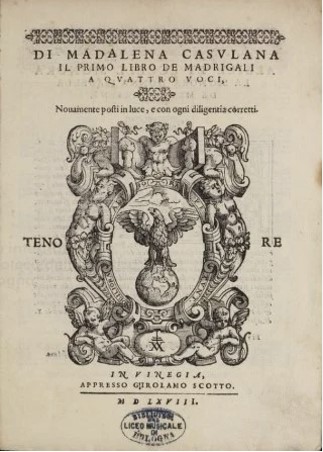
Casulana’s first set of four madrigals was published in Giuglio Bonagiunta’s Il Desiderio I in 1566. She followed this two years later with a volume of her own work, First Book of Madrigals for Four Voices. This was dedicated to Isabella de’ Medici; Casulana wrote in the introduction, “I know truly most excellent Lady, that these first fruits of mine, flawed as they are, cannot produce the effect that I desire, which would be in addition to providing some evidence of my devotion to Your Excellency, also to show the world the futile error of men who believe themselves patrons of the high gifts of intellect, which according to them cannot also be held in the same way by women. Because of all this, I did not wish to fail to publish them, hoping that in Your Excellency’s bright name they would achieve such light as might kindle some other, higher talent to succeed more clearly in that which except for the spirit, I have not been able to show.”
The four-part madrigals in Bonagiunta’s Il Desiderio I appear alongside madrigals by Orlando di Lasso and Cipriano de Rore, among others, revealing the respect that Casulana already had among musicians and poets. Peter Schubert said, “Her madrigals exhibit not only what she must have learned singing poetry to the lute, but mastery of sophisticated compositional craft as well. This skill is particularly evident in her handling of chordal music, a basic feature of the mid-sixteenth-century madrigal arioso.” Melanie Spiller said, “Her harmonic effects are often striking. . . . Her use of dissonance is also masterful and modern, often sprinkled with dominant seventh chords, approached and resolved in the usual way, at a time when this chord could hardly be found elsewhere, except in the music of such composers as Cipriano Rore, Adrian Willaert, or Orlando di Lasso.”
My classical music post for today is Maddalena Casulana’s Il Desidero I: No. 3, Morir non può il mio cuore.


Leave a Reply