

The first work of a classical composer can provide a glimpse of who that composer will become, or it can seem as if it was written by a totally different musician. This November, the Daily Classical Music Post will explore some first works (or Op. 1 works, not always the very first work) by composers familiar and unfamiliar.
Barbara Strozzi – Con le belle non ci vuol fretta (1644)
The Italian composer Barbara Strozzi (1619–1677) was the illegitimate daughter of (most likely) the poet and librettist Giulio Strozzi; at least, he did acknowledge her as his daughter and also helped her establish her musical career. She grew up in her father’s Venetian household, where she was able to learn from some of the greatest literary and musical talents of the day. She grew up as a free spirit; although she never married, she had at least three children, and very possibly more.
Strozzi printed eight collections of vocal music. Beth L. Glixon says that she was “the most prolific composer—man or woman—of printed secular vocal music in Venice in the middle of the [17th] century,” quite an accomplishment. With the exception of one collection of sacred songs, all of her work was secular. Although she used texts by poets and librettists, she sometimes wrote her own lyrics, which were highly regarded.
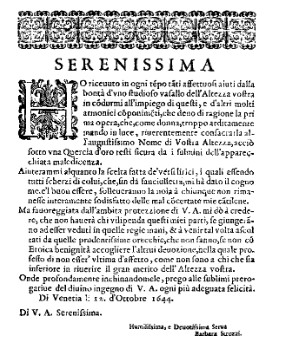
Robert Greenberg said, “Barbara’s first publication—of an eventual eight—is a volume of madrigals appropriately entitled Il primo libro de’madrigali (‘First Book of Madrigals’). Published in 1644 when she was 25 years old, the volume contains madrigals for two to five voices set to texts by her father, Giulio Strozzi. That she was acutely aware of the special challenges of being a woman composer is made explicitly clear in the preface, in which she wrote: ‘Being a woman, I am concerned about publishing this work. Would that it lie safely under a golden oak tree and not be endangered by swords of slander which have already been drawn to battle against it’.”
Andrew Benson-Wilson said, “There certainly would not be anybody who would have not been entirely pleased with the language of Strozzi’s harmonies. Her music is a mini encyclopedia of mid-17th-century Venetian musical styles. The vocal textures ranged from two to five voices, with continuo accompaniment improvised from a line of single bass notes.” Today’s selection is one of the four-part madrigals, and it is absolutely stunning.
My classical music post for today is Barbara Strozzi’s Madrigali, Op. 1: Con le belle non ci vuol fretta.


Leave a Reply