

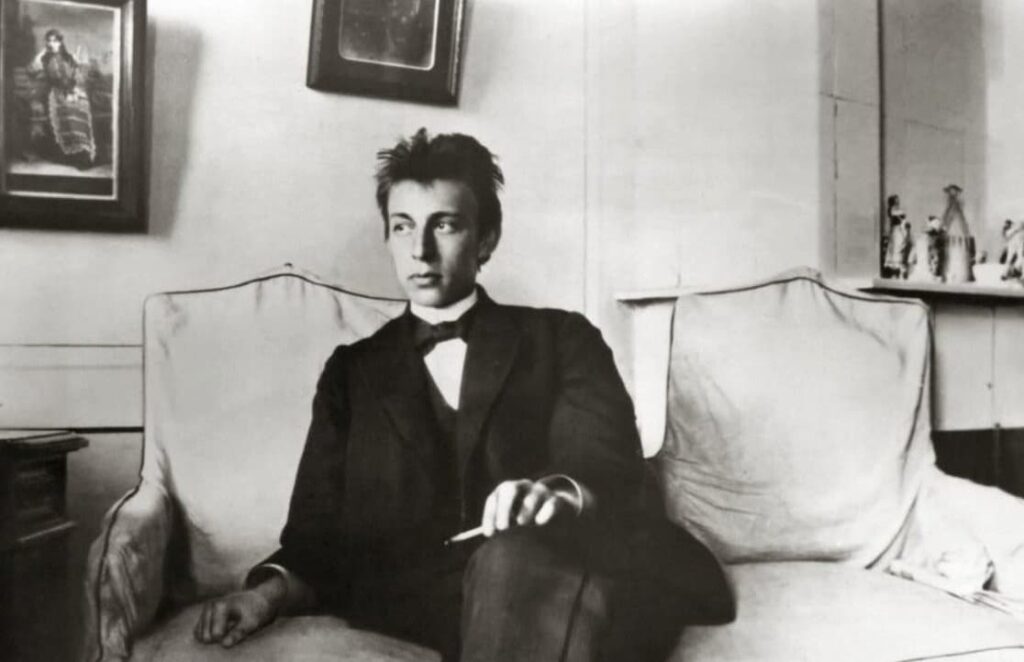
The first work of a classical composer can provide a glimpse of who that composer will become, or it can seem as if it was written by a totally different musician. This November, the Daily Classical Music Post will explore some first works (or Op. 1 works, not always the very first work) by composers familiar and unfamiliar.
Rachmaninoff: Piano Concerto No. 1 in F-Sharp Minor, Op. 1 – I. Vivace
The Russian composer and virtuoso pianist Sergei Rachmaninoff (1873–1943) is well known for his piano concertos and other piano works. His works are expressive, emotional, melodic, and the orchestral parts are full and rich.
Rachmaninoff began composing his Op. 1, the Piano Concerto No. 1 in F♯ minor (1891), when he was 17 years old. Even from the beginning of the first movement, his signature sequential patterns can be heard. He was a fan of Edvard Grieg’s piano concerto and said that he based his first piano concerto on the Grieg one, particularly with regard to the musical structure of the first and third movements. The premiere of the first movement took place in Moscow with the composer at the piano.
Interestingly, this was not Rachmaninoff’s first attempt at composing a piano concerto. Two years earlier, he had begun work on a concerto in the same key as his Piano Concerto No. 2, but he abandoned that early piece. After composing the first piano concerto, he composed the second and third concertos, both of which became popular almost immediately. The first concerto got lost in the shuffle.
In 1917, he completely revised the first piano concerto, but by then most concertgoers were much more interested in the second and third concertos, and so the first remained unperformed for the most part. A writer on ClassicFM said, “As you listen to the concerto, you can’t help but hear the emergence of all the musical skills that were truly to come to fruition in the Piano Concerto No. 2. Fiery keyboard passages, heart-wrenching tunes, and sumptuous orchestral accompaniment are all present here, yet came to the fore only some ten years later when work began on Rachmaninov’s second and most famous concerto.”
Georg Predota said, “Rachmaninoff had grown increasingly dissatisfied with the original version, and he gave the orchestration greater clarity and tightened the overall structure. Benefitting from his development as a composer, Rachmaninoff thinned the texture in both the orchestral and piano parts, and transformed a work of youthful vivacity into a concise and spirited work. . . . Rachmaninoff was highly satisfied with his attempt and reports, ‘I have rewritten my First Concerto; it is really good now. All the youthful freshness is there, and yet it plays itself so much more easily.’”
My classical music post for today is Sergei Rachmaninoff’s Piano Concerto No. 1: I. Vivace.


Leave a Reply