

The first work of a classical composer can provide a glimpse of who that composer will become, or it can seem as if it was written by a totally different musician. This November, the Daily Classical Music Post will explore some first works (or Op. 1 works, not always the very first work) by composers familiar and unfamiliar.
The Austrian composer Alban Berg (1885–1935) was one of the most important composers of the Second Viennese School. His twelve-tone works are considered to be more Romantic and “emotional” than those of his contemporaries, including his teacher, Arnold Schoenberg.
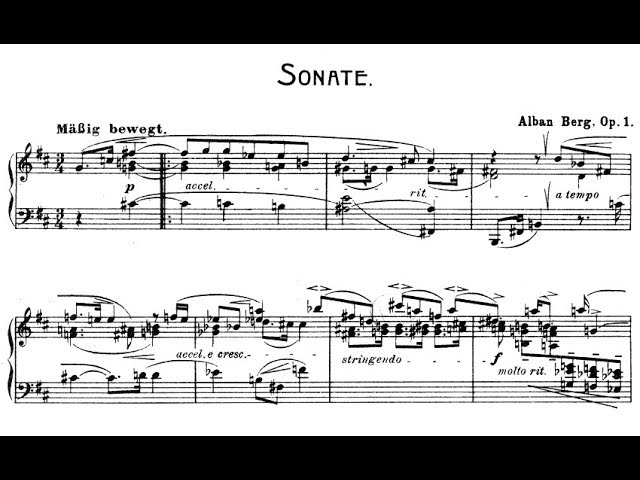
Berg’s Op. 1 was published in 1910, although it was most likely composed at least a year before that. It is the only piano work to which Berg assigned an opus number. Originally planned as a traditional sonata in three movements, this work ended up with just one movement, mostly because Berg ran out of ideas. Schoenberg told him that was because he had said all that needed to be said in the one movement.
David Fick said, “As early as this Piano Sonata, the trademarks of Berg’s mature style seemed fully formed. Unlike with the juvenilia of other composers, Berg’s early work contains none of the underdeveloped harbingers that might suggest more to come. Those qualities which characterize his music from the 1920s (in works such as the Lyric Suite and the Chamber Concerto)—descending third sequences from which melodic figures are generated, intensive use of whole-tone chords, and harmonic progressions that belie strict allegiance to conventional parallelism—persist as prominent ‘topics’ of foreground discourse in Berg’s music.”
Grant Hiroshima said, “The sonata, despite its harmonic adventures, sounds firmly rooted in a late Romantic musical language. In fact, though no specific key is indicated, the piece hovers around the key of B minor—a key it shares with another great one-movement Romantic sonata, that of Franz Liszt.”
My classical music post for today is Alban Berg’s Piano Sonata, Op. 1.


Leave a Reply