

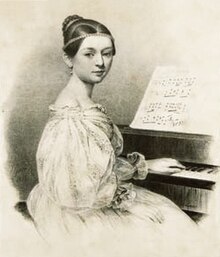
The first work of a classical composer can provide a glimpse of who that composer will become, or it can seem as if it was written by a totally different musician. This November, the Daily Classical Music Post will explore some first works (or Op. 1 works, not always the very first work) by composers familiar and unfamiliar.
Clara Schumann – 4 Polonaises Op. 1 (audio + sheet music)
You’ve probably noticed that the majority of first works or Op. 1s seem to be works for piano. And today’s selection is no different.
Clara Schumann (née Clara Josephine Wieck; 1819–1896) was one of the most influential pianists of the Romantic era. She was also a composer, although for a long time she was not recognized as such. She didn’t even rate herself; she said, “I once believed that I possessed creative talent, but I have given up this idea; a woman must not desire to compose—there has never yet been one able to do it. Should I expect to be the one?” Well, yes, she should have expected to be the one. And she is now recognized as one of the greatest composers of the 19th century.
Schumann composed her Op.1, Quatre Polonaises pour le pianoforte, in 1831. Bryce Morrison said, “Certainly her Op 1 (composed when she was 11) suggests a startling precocity before her skill deepened over the years into music where outward conventions thinly disguise a highly personal and poetic nature.” Even though this is a very early work (perhaps her first), it shows the assuredness and virtuosic writing of her later, more mature compositions.
A review in Iris in 1831 of Schumann’s first performance of the Polonaises said, “From a woman? No; this time from a little girl who is yet to become a woman. As far as we know, the young composer is just ten or eleven years old and already a very accomplished pianist. Early accomplishments are no barrier to future performance; in fact, it is certain that those who are early achievers generally accomplish later on as well. The polonaises that lie before us are quite artful; at times the harmonies are a bit forced, often too dissonant, yet not without talent and with a good rhythm. Small details are very likable.” And another review soon after in Allgemeiner Musikalischer Anzeiger said, “These pieces are good; indeed better than so many of her colleagues, and that pleases us doubly.”
My classical music post for today is Clara Schumann’s Quatre Polonaises pour le pianoforte.


Leave a Reply