

The first work of a classical composer can provide a glimpse of who that composer will become, or it can seem as if it was written by a totally different musician. This November, the Daily Classical Music Post will explore some first works (or Op. 1 works, not always the very first work) by composers familiar and unfamiliar.
Peter Maxwell Davies: Sonata for Trumpet and Piano (1955)
Almost all of the nearly 50 early works by the English composer Peter Maxwell Davis (1934–2016) are unpublished, partly because they were written when he was very young. It’s a shame that none of those early works are available, as it would be a fascinating glimpse into the development of one of the most important classical music voices of the second half of the 20th century. Richard E. McGregor said in an article on Maxwell Davies’ early works, “No compositions are available for general study before the Trumpet Sonata, op.1 (1955), but those that have been seen by friends and colleagues are variously described as being ‘remarkably traditional’ and showing influences ‘such as Bartók’.”
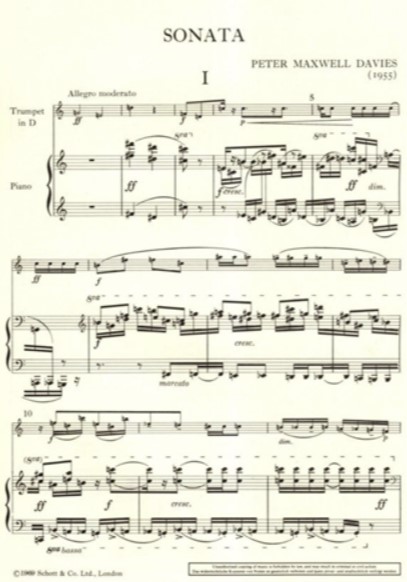
Maxwell Davies employed medieval compositional techniques in his music throughout his career, and this trend is already somewhat apparent in the Sonata for Trumpet and Piano. For example, the use of a talea (described in the post on Du Fay earlier this month) is introduced in the first 12 bars of the work. Maxwell Davies also uses other medieval devices such as color, particularly in the bass part of the piano. (Color is common in isorhythmic compositions; it is a sequence of repeated notes in the cantus firmus and generally is divided into several taleae.)
McGregor said, “Another feature of Davies’s mature style which one can trace in the early works is his penchant for formal symmetries and/or architectural ‘construction’ after classical models. Even in the Trumpet Sonata sections are clearly delineated, in fact more so because of the juxtaposition of such strongly contrasted ideas (which, according to Robert Henderson, reveals the composer’s inexperience). But for all the proliferation of detail in the first movement of the Sonata, it is interesting to note that the set-progression is palindromic (as is the second of the Five Piano Pieces, op.2). Here we glimpse the essence of Davies’s compositional ethos—apparent freedom in a rigid technique.”
Kathryn James Aducci said, “The Sonata for Trumpet and Piano by Peter Maxwell Davies is one of his earliest works, and a notoriously difficult work to perform. While using serialism and other twentieth-century compositional techniques, this work also uses older historical forms, including sonata-allegro and sonata-rondo forms.” The Sonata impressed many people and led to Maxwell Davies’ first publishing contract.
My classical music post for today is Peter Maxwell Davies’ Sonata for Trumpet and Piano.


Leave a Reply