

The first work of a classical composer can provide a glimpse of who that composer will become, or it can seem as if it was written by a totally different musician. This November, the Daily Classical Music Post will explore some first works (or Op. 1 works, not always the very first work) by composers familiar and unfamiliar.
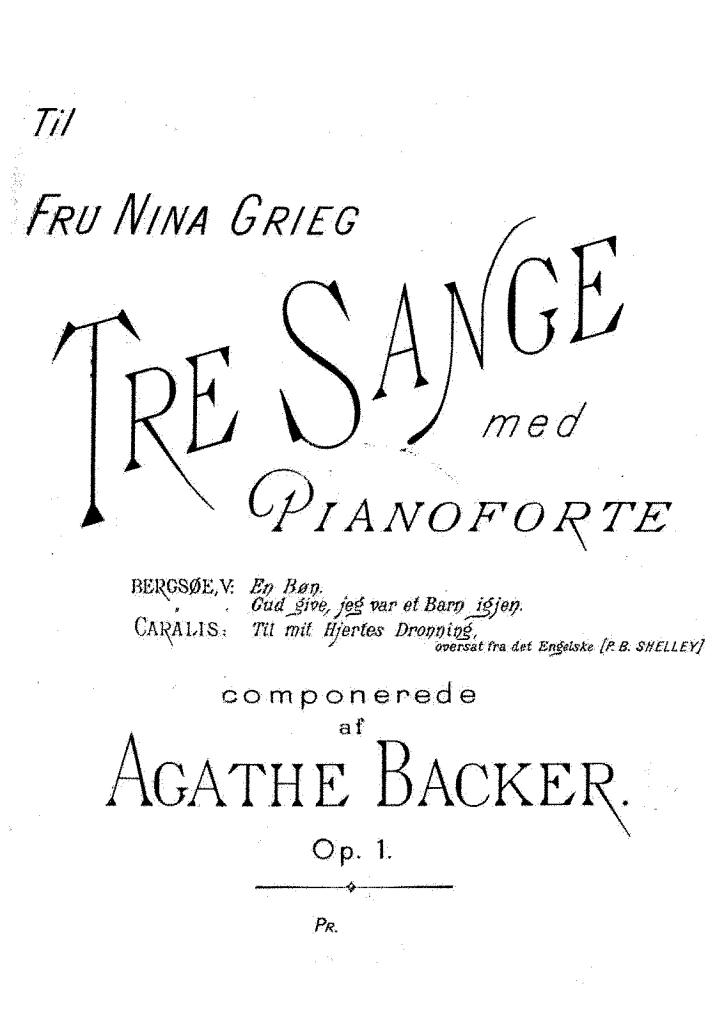
Tre Sange, op. 1 by Agathe Backer Grøndahl
The Norwegian pianist and composer Agathe Backer Grøndahl (1847–1907) was extraordinarily prolific; her output includes more than 400 pieces. She was a good friend of Edvard Grieg, and musicologists count her among the major composers of Norway’s golden age of music. Among her teachers were Hans von Bülow and Franz Liszt. Her early compositional style was quite typical of 1850s Europe but she actually anticipated impressionistic style in her later works.
Her performing career ended in 1903 mainly because her hearing had deteriorated to the point that by then she was completely deaf. Yet she continued composing and teaching for the next four years. Natasha Loges said, “Backer Grøndahl composed approximately 180 songs, including numerous folksong arrangements. She favoured clear, symmetrical forms enriched with adventurous harmonies. Exceptionally, nearly all her music was published during her lifetime. . . . Her songs are enormously appealing, with a tendency towards varied strophic settings, highly singable melodies and well-crafted, characterful accompaniments that do not overwhelm the voice.”
Backer Grøndahl’s Op. 1, Tre Sange, was composed in 1868–1869 and was dedicated to Grieg’s wife Nina, who was a well-known lyric soprano. As with many of Backer Grøndahl’s early works, her Op. 1 was written for voice and piano. The text of the first two songs was by the Danish poet Vilhelm Bergsøe. The text of the third song was attributed to Percy Bysshe Shelley but in fact was written by the British writer James Augustus St. John by way of Caralis (the pseudonym adopted by the Danish translator Christian Preezmann). The poetry and virtuosity of the piano and vocal writing in this work makes it clear why Backer Grøndahl’s music was so popular.
My classical music post for today is Agathe Backer Grøndahl’s Tre Sange.


Leave a Reply