

The first work of a classical composer can provide a glimpse of who that composer will become, or it can seem as if it was written by a totally different musician. This November, the Daily Classical Music Post will explore some first works (or Op. 1 works, not always the very first work) by composers familiar and unfamiliar.
Serenade No. 1 for Ten Winds (I. Prelude; II. Episode; III. Song; IV. Interlude; V. Dance)
The name of the American composer Vincent Persichetti (1915–1987) is most likely well known to anyone who played in their school band or orchestra, as he composed many works for those ensembles. He also composed works for choir, and his Hymns and Responses for the Church Year is a standard setting for church choirs. He is one of the major figures of 20th-century classical music, not just as a composer but also as a highly influential and important teacher. Among his students were Philip Glass and Steve Reich.
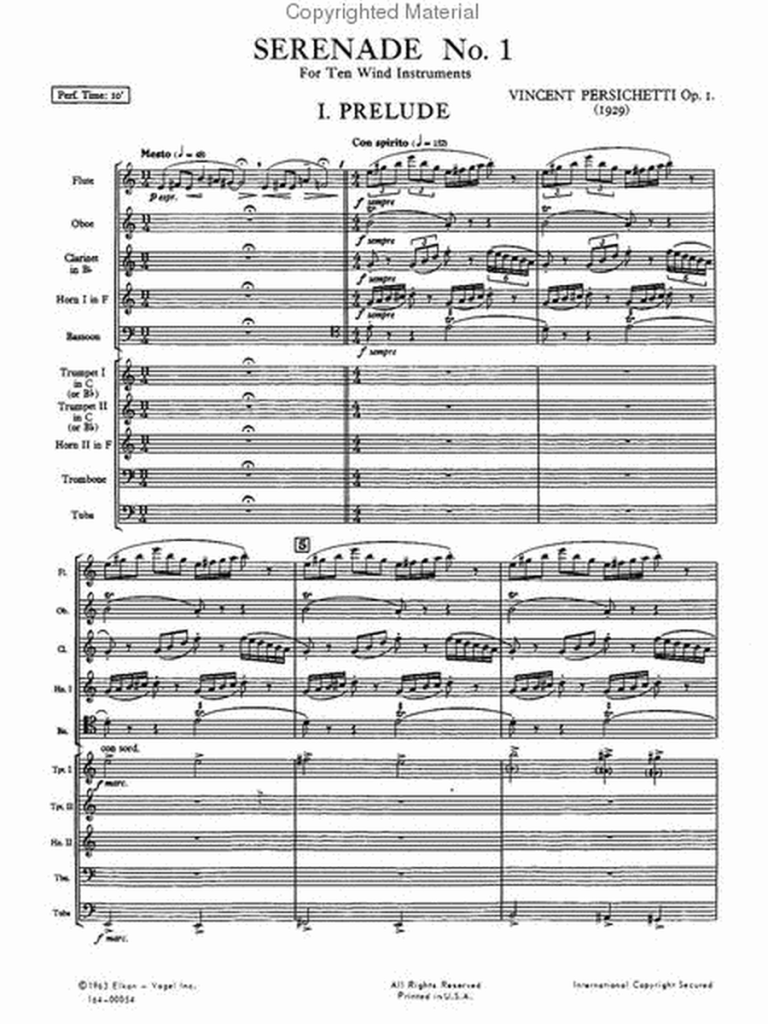
Persichetti composed Serenade No. 1, Op. 1 in 1929. The instrumentation is very interesting: woodwind quintet and brass quintet (flute, clarinet, oboe, bassoon, horn, two trumpets, horn, trombone, and tuba). There are five movements, around 1.5 minutes to 2 minutes long each. As with many of Persichetti’s early works, the influences of Igor Stravinsky can be, but it also shows signs of polytonality and unique treatment of rhythm and melody, signature Persichetti style.
Persichetti said, “The Serenade, composed when I was fourteen, built on a chorale melody written at nine, was one of the contraband pieces of the period. I wrote it away from the [Combs] Conservatory, but under the unofficial eye of Russell King Miller. I was allowed to compose this kind of music as a reward for double assignments in stylistically severe chorale harmonization and cantus firmus contrapuntalizations. I poked fun at the predictably academic and often got in trouble with my teachers. The Serenade was first performed at a concert for alumni on December 21, 1929, by instrumental colleagues interested in music after Tchaikovsky. I managed to round up a violinist to play the flute part, a fine oboist, and a questionable tubist; the remaining seven parts I had to cover myself on a tracker organ. (I’d started organ at eleven, as soon as my legs were long enough to reach the pedals.)”
Walter Simmons said, “The Serenade, Op. 1, for ten winds, while not terribly important in its own right, is fascinating as a demonstration of the degree to which Persichetti had already found a mature compositional voice by the age of 14. True, the expected influence of Stravinsky can be heard. But also evident in this work are the more than frequent use of polytonality, the use of repeated dissonant chords as mocking punctuations, the tendency toward building a work from tiny epigrammatic movements, and the disposition toward wind instruments—all these are still central aspects of the composer in his sixties.”
My classical music post for today is Vincent Persichetti’s Serenade No. 1.


Leave a Reply