

The first work of a classical composer can provide a glimpse of who that composer will become, or it can seem as if it was written by a totally different musician. This November, the Daily Classical Music Post will explore some first works (or Op. 1 works, not always the very first work) by composers familiar and unfamiliar.
Mahler: Das klagende Lied | Sydney Symphony Orchestra | Digital Season
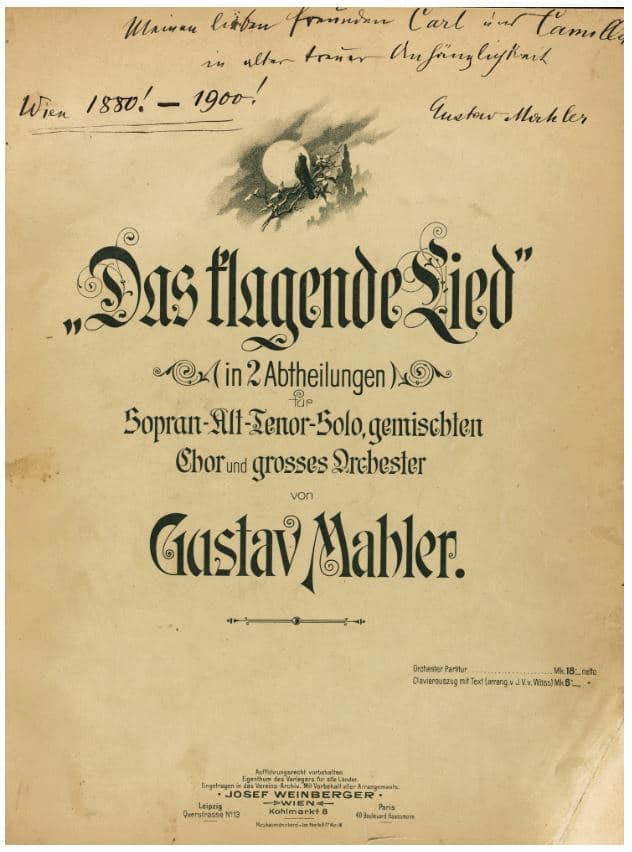
The Austro-Bohemian Romantic composer Gustav Mahler (1860–1911) was very dissatisfied with most of his student compositions at the Vienna Conservatory (he was there from 1875 to 1878) and probably destroyed many if not all of them. Apparently his first foray into symphonic writing was panned by the director of the Conservatory because there were some copying errors. Mahler’s career at the Conservatory ended when he was 18 years old with a diploma but no medal, and he went on to study literature and philosophy at the University of Vienna. It was shortly after this that he composed his Op. 1, a cantata titled Das klagende Lied (The Song of Lamentation). The work was completed in 1880 but was not performed until 1901, and then only in a shortened form.
Mahler had actually begun work on Das klagende Lied while he was still at the Conservatory (he said that this was “the first work in which I found myself as Mahler”). He based it on the Brothers Grimm’s “Der singende Knochen,” a pretty harrowing tale of brotherly rivalry and murder. Das klagende Lied was originally in three parts, but by the time of the first performance he had substantially revised it, reducing the size of the orchestra as well as the choir and soloists. In the end, Das klagende Lied became a two-part work (Part 1 was jettisoned entirely), and this is the version that entered the repertoire.
Mahler wrote his own libretto. In addition to the Brothers Grimm work, he included references to fairy tales by Ludwig Bechstein. He entered the cantata for the 1881 Beethoven Prize, hosted by the Gesellschaft der Musikfeunde. Unfortunately for him, one of the judges was Johannes Brahms, who was extremely hostile towards Mahler possibly because he was a disciple of Anton Bruckner. Mahler was convinced that had he won the prize, his whole life would have gone very differently. It didn’t help that a contemporary reviewer said that the work had just a “few rare moments of touching and authentic music, some remarkable and vividly defined moods… original but terribly laboured harmonies and orchestral experiments that reveal an unquiet spirit and a veritable cult of the ugly. Mahler created a flood of ugliness.”
I actually totally disagree with that assessment. Das klagende Lied is a fascinating work, incredibly atmospheric and foreshadows the monumental composer that Mahler would become. It’s a long listen, over an hour and a quarter, but well worth it if you have the time.
My classical music post for today is Gustav Mahler’s Das klagende Lied.


Leave a Reply