

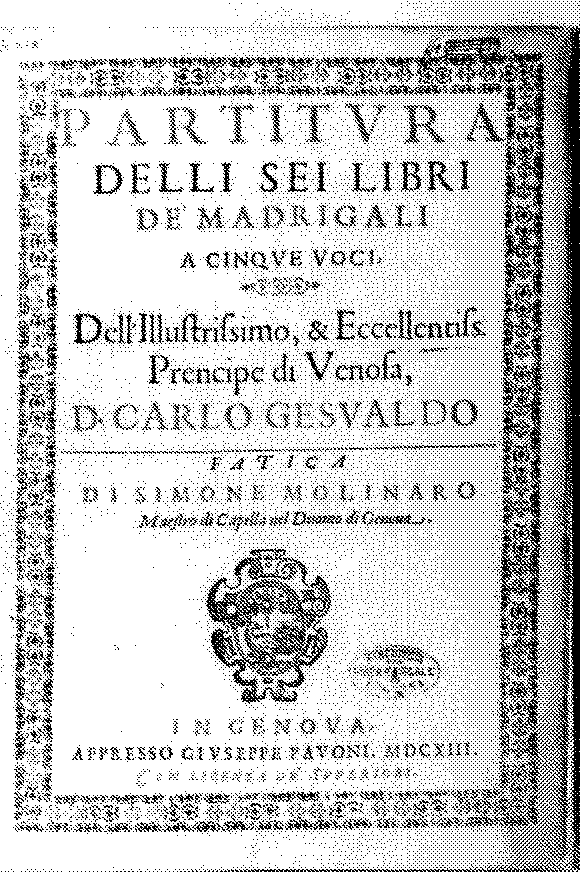
The first work of a classical composer can provide a glimpse of who that composer will become, or it can seem as if it was written by a totally different musician. This November, the Daily Classical Music Post will explore some first works (or Op. 1 works, not always the very first work) by composers familiar and unfamiliar.
Madrigals. Book I – Carlo Gesualdo
Carlo Gesualdo (?1566–1613), Prince of Venosa and Count of Conza, was an Italian nobleman, lutenist, composer, and murderer. His music is among the most experimental and expressive of the Renaissance, and without question is the most wildly chromatic. He wrote musical progressions that did not appear again in music until the 19th century. In 1590, he murdered his first wife and her lover, and then left their bodies in front of his palace so that everyone could see what he had done. Because he was a nobleman he could not be prosecuted, but in his music the way that he set words including “love,” “pain,” “death,” “ecstasy,” and “agony” can be seen as evidence that he was tortured by guilt for the rest of his life.
Four years after the murders, Gesualdo published his first book of madrigals, for five voices, Op. 1. The 15 madrigals in this collection set a variety of texts by contemporary poets including Giovanni Battista Guarini, Alessandro Gattie, Torquato Tasso, and Angelo Grillo. David Vernier said, “Although certainly not devoid of chromaticism and hints of Gesualdo’s later ventures into sometimes bizarre harmonic territory, these works are overall more conventional in their expressive techniques—but what expression and what techniques! You won’t hear more effectively written musical representations of the passion, pain, longing, or other of love’s emotions portrayed in the poetic texts (primarily by Torquato Tasso) from any composer of the period.” Gesualdo actually published this first book under the name of a family friend, Giuseppe Pilonii. Although he was never convicted of the murders, and in fact it was determined that he had not committed a crime (!), it probably was a good idea to stay under the radar for a while.
Marco Longhini said about the first madrigal in this collection, “The sophisticated erotic play throughout this madrigal, with its frequent gasps and sighs, conjures up a scene of love-making, which becomes explicit once we understand the courtly linguistic conventions of the day—the word “morire” (to die) being a euphemism for sexual orgasm. . . . Gesualdo’s music for Book One . . . is clearly the work of a mature composer, not the first tentative approach of a young musician to the publishing world: it is a book to be loved, read and reread.”
My classical music post for today is Carlo Gesualdo’s Madrigals, Libro 1, Op. 1.


Leave a Reply