

The first work of a classical composer can provide a glimpse of who that composer will become, or it can seem as if it was written by a totally different musician. This November, the Daily Classical Music Post will explore some first works (or Op. 1 works, not always the very first work) by composers familiar and unfamiliar.
The American composer Florence Price (1887–1953) was the first Black composer to have a work performed by a major symphony orchestra. She composed well over 300 works, and in 2009 a collection of her manuscripts was found, renewing interest in this brilliant classical musician. Interestingly, Price wanted to be a doctor, but thought that becoming a classical composer would be less difficult! Although she did enjoy success in her lifetime, it has only been recently that, as John Michael Cooper said, her music has been heard and celebrated again following the “forcible silencing that was her lot as an African American and a woman in a profoundly racist and sexist world.”
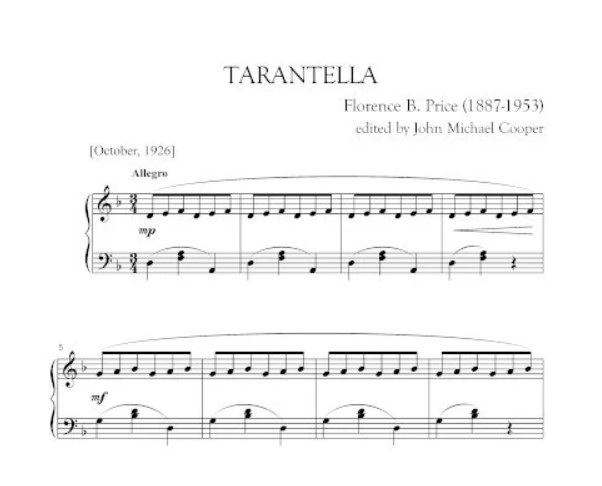
One of her earliest works, Tarantella for piano, dates from 1926. The manuscript for this work (there actually are two separate autographs) is in the Special Collections of the University of Arkansas Libraries in Fayetteville. There is an inscription on the folder in which the manuscript was found: “TARANTELLA / For Pianoforte. / By / Florence B. Price.” Cooper said, “In concert music of the nineteenth and twentieth centuries, the tarantella is always rapid and features running scales that lead to strong punctuating chords—as seen in the Price composition presented here. The work is in the rondo over A – B – A – Coda form typical of dance movements in concert music, with the central section being in the parallel major and presenting a lyrical theme first as a solo melody and then as a harmonized duet in parallel thirds over a more relaxed, but still rapid accompaniment.”
Scott Yoo said about Tarantella, “This is one of the first dateable compositions [by Price] that has been recovered. . . . It’s interesting that she’s writing kind of a European form in the deep South.” Price had studied at the New England Conservatory of Music, and the influence of her teachers, including George Chadwick and Frederick Converse, is apparent in Tarantella. Price evidently enjoyed the tarantella form; six years later, she used a tarantella-like theme in the final movement of her award-winning Piano Sonata in e minor (1932).
My classical music post for today is Florence Price’s Tarantella.


Leave a Reply