

Politics can shape music just as music can express political ideas. This October, the Daily Classical Music Post will look at some of the music written as a protest, commemoration, or statement of political beliefs.
Ballard: Incident at Wounded Knee
Louis Ballard (1931–2007), known as the father of Native American composition, was Cherokee and Quapaw, and his Quapaw name, Honganozhe, is translated as “One Who Stands With Eagles.” Although Ballard received Western musical training, and later studied with Darius Milhaud and Mario Castelnuovo-Tedesco, he also was deeply involved in the music of his culture, and his music reflects this fusing of different styles. He was inspired by Béla Bartók’s use of Hungarian folk music as well as Antonín Dvořák’s ideas about what American classical music should be and once said, “Dvorak, in 1893, predicted that America should have a form of nationalistic music built upon Indian music and Black slave songs. So I felt that I was in good company when I took up my pen to express the sufferings of my people, their regeneration and hopes for a better future life.”
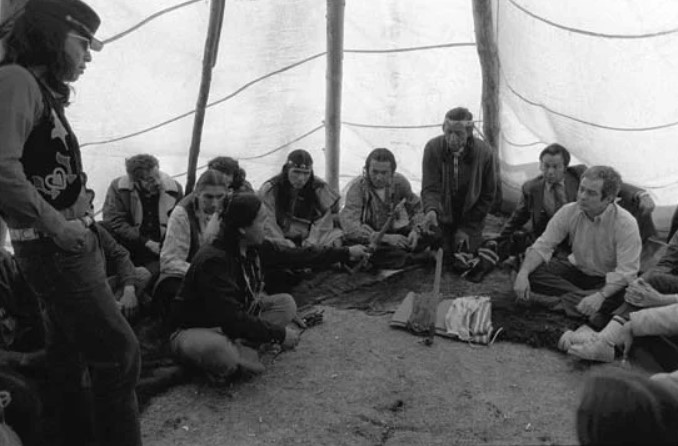
Richard LaFortune said, “In 1974, a year following the 71-day protest occupation on the Pine Ridge Reservation, Ballard was asked to consider the generational impact of Wounded Knee in two separate centuries in a commission by the SPCO [Saint Paul Chamber Orchestra] and Dennis Russell Davies. The world premiere brought focus to an event that had captured world media attention and had brought the US government to the negotiating table to review the state of 371 broken treaties with Native American peoples, all of which were fresh in the public’s memory.”
It is not easy to find a recording of the powerful Incident at Wounded Knee on the Internet. The link above will take you to a webpage with information about the piece and then, when you scroll down, to a video of a 2022 live performance by the Saint Paul Chamber Orchestra. The four-movement piece is not really programmatic, but it is quite emotional. Ballard said at the time, “A series of musical episodes depict the emotional procession toward the town, the state of the souls in torment, and the violent conflict. The work culminates in musical and dance forms affirming the essential spirituality of Native American people. Incident is not a political work, but it drew a strong reaction from oppressed peoples when it was played in Poland and Czechoslovakia, as well as the cities of Western Europe. The fact that I was taking a bow onstage with a white American orchestra and conductor did more than words can to show that we live in a free country.”
My classical music post for today is Louis Ballard’s Incident at Wounded Knee.


Leave a Reply