

Politics can shape music just as music can express political ideas. This October, the Daily Classical Music Post will look at some of the music written as a protest, commemoration, or statement of political beliefs.
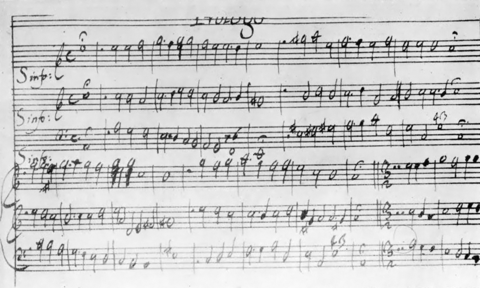
L’Incoronazione di Poppea, SV 308: Symphonie
The Italian composer Claudio Monteverdi (1567–1643) used his operas to portray the corruption and political intrigue that he observed in the small Italian courts where he studied and worked. L’incoronazione di Poppea (1643), his final opera, depicts cruelty, adultery, and lack of morality (yes, of course, this is mostly due to the librettist, Giovanni Francesco Busenello, but Monteverdi would definitely have had input). There is some dispute as to whether or not all of the music is indeed by Monteverdi, but most scholars accept Poppea as his last and greatest work. It is the first major opera that survives to feature human beings as protagonists, and it was a definite attempt to confront the people of Venice by using opera to highlight their moral decline.
Samantha Horn said, “[T]he 1600s saw a relapse into political oppression and social instability fueled by depressed economic conditions and the Catholic Church’s repressive Counter-Reformation efforts. By mid-century, these conditions had conspired to produce a new set of cultural values among the Italian elites, favoring the frivolous over the profound, scholarly apathy over worldly engagement, extravagance of language over classical rhetoric, and emotional restraint over naturalistic expression. . . . It was in this climate that Claudio Monteverdi composed his final opera, L’incoronazione di Poppea.” Stephen Carr said, “In its historical context, Poppea is a cautionary tale; though it ends with a seemingly joyful coronation, Monteverdi’s audience knew that Poppea and Nero’s triumph was short-lived.”
There is nothing virtuous or honourable about the characters. Sarah Hibberd said, “Though the intentions behind the comparison of ancient Imperial Rome and modern Republican Venice remain unclear, the shocking sensuousness of such duets as ‘Pur ti miro’—in which the vocal lines of the emperor (a castrato role) and Poppea entwine in the same register—demonstrates how music can persuade an audience to sympathise with its characters, however repellent they may be.” Meanwhile, the music is peak Monteverdi: creative, beautifully harmonic, melodically diverse, and there even are leitmotifs, an innovation. David Schulenberg has pointed out that Poppea “reveals the sure hand of a veteran composer who could readily draw vivid characters and organise this attractive operatic play, mainly through recitative.”
My classical music post for today is Claudio Monteverdi’s L’incoronazione di Poppea: Symphonie.


Leave a Reply