

Politics can shape music just as music can express political ideas. This October, the Daily Classical Music Post will look at some of the music written as a protest, commemoration, or statement of political beliefs.
Squire Woods Lamentation – Celtic Harp tune by Carolan
The blind Celtic harper Turlough O’Carolan (1670–1738) is considered to be Ireland’s national composer, although he wasn’t a classical composer in the strictest sense of the term. However, the influence of European classical music can be heard in some of his compositions, as well as strands of older Gaelic harp music.
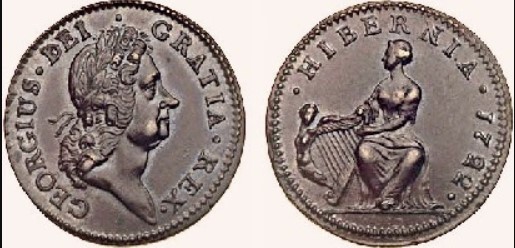
In 1722, the English hardware manufacturer and mine owner William Wood was given authorization by the King of England to produce copper halfpence coins and farthings for Ireland. There was widespread anger in Ireland about this, partly because the Irish authorities had not been consulted about this and partly due to the popularity of Jonathan Swift’s pamphlets Drapier’s Letters (so named because Swift used the pseudonym “Drapier”). Swift said in the pamphlets that the coins were of inferior quality and, anyway, why was someone in England making money from making money for Ireland? Swift said that Ireland was constitutionally and financially independent of Britain and therefore the coins should be boycotted. There was indeed a boycott, and the coins were recalled, although they later turned up in the British North American colonies.
O’Carolan, who was acquainted with Swift, imagined that Wood was upset about the boycott, and wrote a lamentation for Celtic harp expressing this sentiment, “Squire Wood’s Lamentation on the Refusal of His Halfpence” (1722). It’s probable that there were words—possibly satirical—that went along with the tune at the time, but if so, they are long forgotten. There are elements of a traditional Irish reel in this quite tongue-in-cheek and very melodic elegy about the loss of a halfpence-minting business.
My classical music post for today is Turlough O’Carolan’s “Squire Wood’s Lamentation on the Refusal of His Halfpence.”


Leave a Reply