

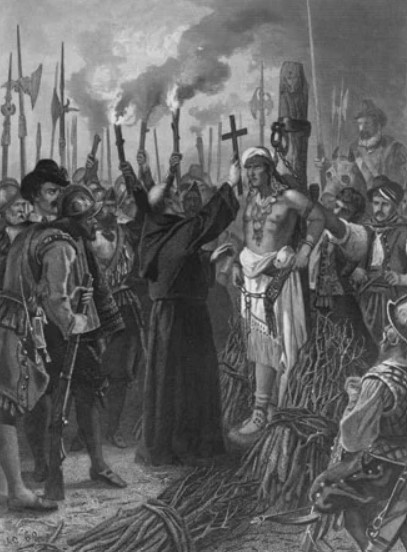
Politics can shape music just as music can express political ideas. This October, the Daily Classical Music Post will look at some of the music written as a protest, commemoration, or statement of political beliefs.
The Uruguayan composer Miguel del Águila (born 1957) fled the repressive regime in Uruguay in 1978 and settled in California. He has been described as “one of the West Coast’s most promising and enterprising young composers” by the Los Angeles Times. In 2008, he was commissioned to compose a work for orchestra by Kathryn Gould’s Magnum Opus project and Meet The Composer. This work, the tone poem The Fall of Cuzco, was premiered by the Nashville Symphony in 2009.
The composer said, “With this work I tried to recreate my fantasy of this mystical place and time, as well as give a voice to those who were silenced as a result of the Conquest almost 500 years ago. As in many of my works, the music here tells a story and suggests imagery. The pantheistic mood of the beginning is followed by an idealized depiction of this pre-columbian Inka world before the collapse. The Andean inspired themes are slowly transformed to convey fear, sadness, betrayal and ultimately the agony of battle and death. The underlying theme is gold and its power over men and their greed. Once Pizarro arrives, the gold theme starts subduing the other three which struggle for their survival throughout the entire piece. Finally, it triumphs and it ends the piece in all its boisterous brilliance. The closing bars depict this mountain of gold, blinding, seductive and overwhelming, while heralding at the same time the birth of a new race in a new America. Having survived myself the ‘Guerra sucia’ of the ‘70’s by the military dictatorships in my native South America—which ultimately forced me to emigrate to the USA—I couldn’t avoid relating Pizarro’s crimes to those of modern dictators like Stroessner and Pinochet and relating the struggle of the Inka to those of my contemporaries.”
There are five sections in The Fall of Cuzco: 1. The dawn of a new day in Cuzco; 2. The arrival of Pizarro; 3. Pizarro captures the Inka king; 4. Gold is brought to Cuzco from all over the land; 5. After all the gold is brought, Pizarro will kill Atahualpa. A review in the American Record Guide said, “In the substantial tone poem The Fall of Cuzco (2009), traditional Andean melodies are subject to a sinister, dissonant undercurrent, later to erupt in violence.”
My classical music post for today is Miguel del Águila’s The Fall of Cuzco.


Leave a Reply