

Politics can shape music just as music can express political ideas. This October, the Daily Classical Music Post will look at some of the music written as a protest, commemoration, or statement of political beliefs.
Josquin Des Prez: Miserere mei Deus
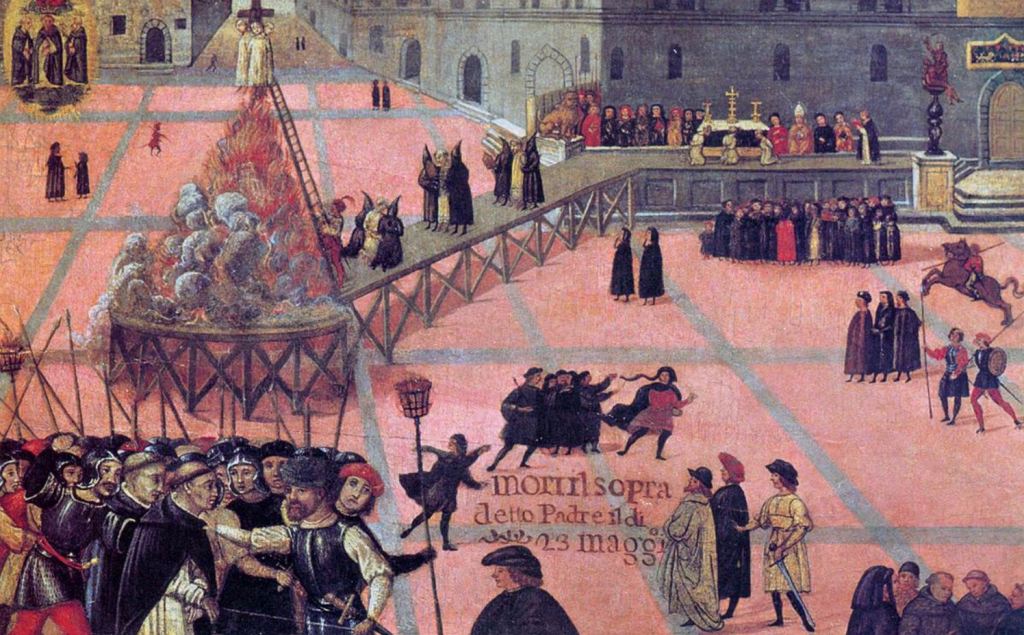
The Dominican friar Girolamo Savonarola was executed in Florence in 1498 because he had called for Christian renewal and reform, and he defied Pope Alexander VI in his campaign against the French. Savonarola was imprisoned and tortured before his execution, and during his time in prison he wrote a meditation on sin and repentance, Infelix ego, based on Psalm 51 (the Miserere). Infelix ego was in part a plea for forgiveness from God, as Savonarola was distressed that he had allowed himself to weaken and recant his beliefs. It became his most famous work and was translated into many European languages. Many 16th-century musicians also set it.
The Franco-Flemish composer Josquin des Prez (c. 1450–1521) alluded to Infelix ego in his setting of the Miserere, written some time around 1504. The structure of Josquin’s Miserere imitates Savonarola’s text, including the refrain “Miserere mei deus” after each verse. At the time that Josquin composed his Miserere, he was in the employ of the Duke of Ferrara, who had been a great supporter of Savonarola. It is believed that the Duke would have sung the tenor part, with its repetitions of “Miserere mei deus,” when Josquin’s setting was sung in the palace chapel.
The Miserere is a motto motet, in which repetition of a particular phrase is structurally predominant. Throughout the motet, the words are clear, something that was not a common feature in church music of the time. Jill Valentine said, “Savonarola disliked the lack of text clarity in imitative music, so Josquin chose sparse texture for this work. Often, only two or three voices at once will sing long, unified rhythms so the text remains easy to understand and the tone is meditative.” Valentine also notes, “In the first part, each refrain of the title text (Miserere mei, Deus) steps downward in pitch—a clever, subliminal aspect to the music’s depiction of depression.”
My classical music post for today is Josquin des Prez’s Miserere.


Leave a Reply