

Politics can shape music just as music can express political ideas. This October, the Daily Classical Music Post will look at some of the music written as a protest, commemoration, or statement of political beliefs.
March of the Women (Ethel Smyth)
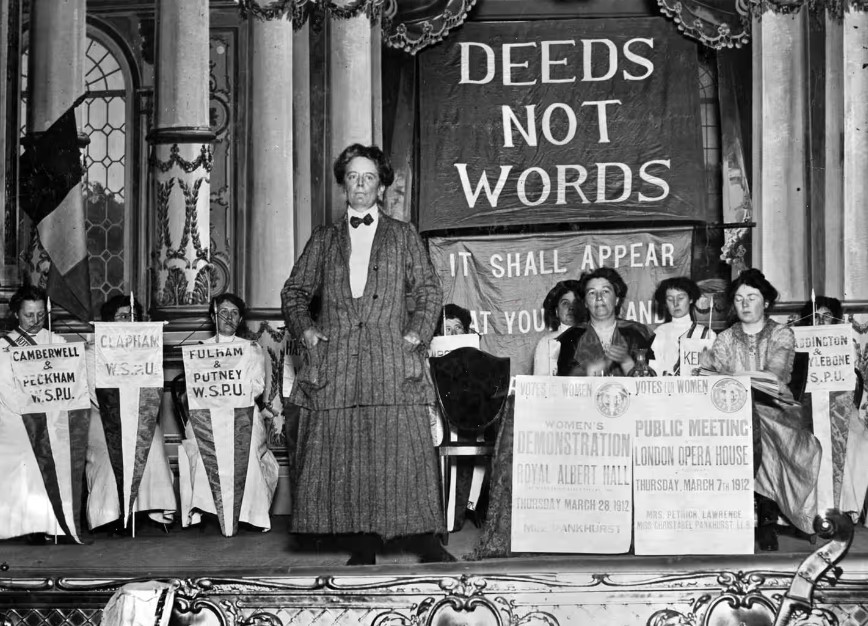
The English composer Ethel Smyth (1858–1944) gave up music for two years after she joined the Women’s Social and Political Union (WSPU) in 1910, as she believed that any disadvantages that women faced in music stemmed from the lack of a political vote and voice. Soon after joining the WSPU, she decided to compose one more work, “The March of the Women” (1911), which was soon adopted by the WSPU as its official anthem. It wasn’t long before “The March of the Women” became more widely known and sung by women throughout the United Kingdom. Hunger strikers also sang it during the struggle for the vote in the United Kingdom. It later was sung by suffragettes in the United States at rallies including those in Washington, DC.
Smyth set poet and fellow WSPU member Cicely Hamilton’s poem to a tune that she had heard when travelling in Italy, adapting it for women’s voices only. BBC Music Magazine Online said, “It’s a simple tune: joyful, in a major key, the lyrics encouraging women to ‘Shout, shout, up with your song’, and to ‘Laugh in hope for sure is the end’. . . . Music was an important part of these rallies—the suffragettes wanted to be heard as much as seen. But until Smyth’s March, no music had been written specifically for the WSPU. . . . ‘The song has in it all the spirit of the Women’s Movement,’ the Votes for Women newspaper enthused; ‘the tenderness, the hope, the faith, and the cheerful and triumphant thrill of victory.’ From 1911 onwards, suffragettes were instructed to learn Smyth’s song by heart so it could be sung at all WSPU events.”
Cait Miller said, “[I]t’s arguable that [Smyth’s] most impactful musical contribution to society is that which came out of her commitment to the WSPU. Upon returning to her professional musical pursuits, she composed a new comic opera to her own libretto, The Boatswain’s Mate. The opera, suggested to be a feminist work by some scholars, features a widowed inn keeper who outwits her insipid male guest after he plots to win her affection. If there is any question as to whether Smyth intended for audiences to think of the opera as a feminist one, perhaps her quotation of ‘The March of the Women’ in the overture settles the issue.”
My classical music post for today is Ethel Smyth’s “The March of the Women.”


Leave a Reply