

Politics can shape music just as music can express political ideas. This October, the Daily Classical Music Post will look at some of the music written as a protest, commemoration, or statement of political beliefs.
[Score Video] Xilin Wang: Symphony No. 3
The Chinese composer Wang Xilin (born 1936) won prizes and accolades in his early career, but his criticism in the early 1960s of Chairman Mao Zedong and Mao’s policies, which included a crackdown on Western music, led to Wang’s banishment and imprisonment. He spent 14 years basically in exile, during which time he was beaten and suffered hearing loss as a result.
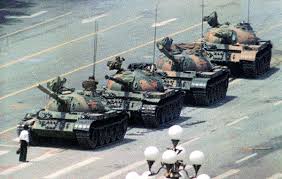
Colin Clarke said, “Returning to Beijing in 1978 after the Cultural Revolution, Wang met the European avant-garde, and his music started to incorporate techniques such as Minimalism and clusters. The four-movement Third Symphony [composed in 1990] is a ‘serious meditation’ on the ten-year-long ‘Great Proletarian Cultural Revolution,’ and was written under the shadow of the massacre at Tiananmen Square. As Wang says, ‘I do not wish to write for myself alone, but to depict this long history and the many aspects of humanity it encompasses; I compose for all those who have died’.”
Rick Perdian said, “The massive work, over an hour in length, is unified by a long sequential melody, introduced first by the cellos and contrabasses. Wang exploits a wide span of percussion sonorities from the beauty of the harp, marimba and xylophone to the menacing rattle of the snare drum. There are splashes of color that offer the prospect of hope, but they are inevitably dashed by cruel military marches, the slap of the whip and terrifying sounds that rain down from the heavens. The pairing of alto flute and cello is particularly evocative, as are the extended solos for English horn. In the final seconds, the music evaporates into thin air.”
Wang was greatly influenced by Russian composers, particularly Dmitri Shostakovich. Clarke again: “There is no doubting the shadow of Shostakovich hangs over the first movement, an Adagio beginning with slow-moving lower strings, to which is added a cor anglais. This long opening melody is used as a unifier in the 65-minute piece. This first movement contains hard-raising climaxes (think Shostakovich and Ives combined, or perhaps layered one atop the other) and moments of restrained terror.”
My classical music post for today is Wang Xilin’s Symphony No. 3.


Leave a Reply