

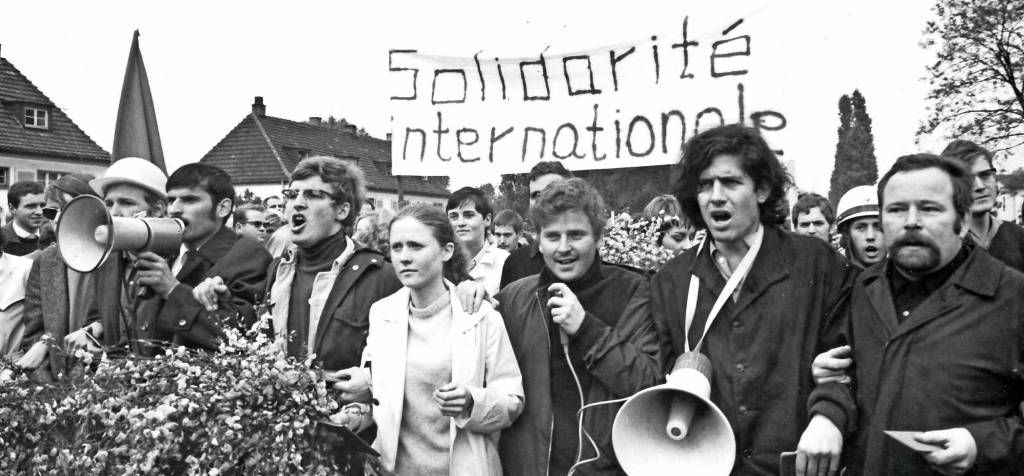
Politics can shape music just as music can express political ideas. This October, the Daily Classical Music Post will look at some of the music written as a protest, commemoration, or statement of political beliefs.
Hans Werner Henze: Versuch über Schweine (1968)
The German composer Hans Werner Henze (1926–2012) composed the sprechstimme “Versuch über Schweine” (Essay on Pigs) in 1968. This work marked an important change in Henze’s compositional style: he began to incorporate his political ideals and protest against the right-wing establishment into his music.
“Essay on Pigs” is written for woodwinds, brass, strings, percussion, “beat organ,” and electric guitar with vocal soloist. The singer is required to use extended vocal techniques (much like those in Peter Maxwell Davies’ Eight Songs for a Mad King).
Donal Henahan says, “This ‘Essay on Pigs’ turns out to be a neo‐Brechtian broadside for voice and instruments, using as its text a pessimistic, searching poem by Gaston Salvatore, a Chilean who had been a leader of the West Berlin students during the 1968 riots there. The pigs, in West German context, are not the police, but the students, who were so often referred to by the conservative public as ‘Schweine’ that they adopted the epithet, rather in the style of our country’s ‘bums’ and ‘snobs.’ The Henze piece had its premiere in London [in 1969] because of the composer’s anger at the police raid that prevented an earlier premiere, in West Berlin, of his relatively innocuous bit of social protest, ‘The Raft of the Frigate Medusa.’ So the ‘Essay,’ which is explicitly revolutionary and contemporary, represents no overnight radicalization, but the final goading into position of a basically conservative artist.”
My classical music post for today is Hans Werne Henze’s “Versuch über Schweine.”


Leave a Reply