

Politics can shape music just as music can express political ideas. This October, the Daily Classical Music Post will look at some of the music written as a protest, commemoration, or statement of political beliefs.
“Va pensiero” from Verdi’s Nabucco
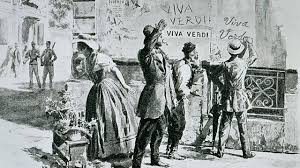
The Italian composer Giuseppe Verdi (1813–1901) is considered to be one of the greatest composers of opera in the history of Western classical music. He was sympathetic to the Risorgimento movement clamoring for Italian unification. The chorus “Va, pensiero” from the third act of Nabucco (1842) was adopted by Italian patriots as, to them, it embodied the spirit of the unification movement. Many Italians considered Verdi, who also had an extremely brief political career, to be a representative of unification ideals. “Viva Verdi,” with the second word representing an acronym for “Vittorio Emanuele Re d’Italia” (the first head of state of Italy), was painted on walls as a way for patriots to express their admiration for Verdi as well as their support for unification.
Victor DeRenzi said, “A chorus is a group of individuals who join to form a musically cohesive community; you are both yourself and part of something bigger than yourself. ‘Va pensiero’ may be the perfect piece for people to come together and perform as a chorus. The melody is simple. It starts with everyone singing in unison, which gives confidence to those who are shy about singing. The experience of performing the same music helps them express their feelings while sharing their feelings with people around them. In the second section, it breaks into harmony, but you can still sing the melody and leave the harmony to those who have the ability to sing it. Finally, the music returns to a unison chorus, where everyone is united again with one voice.”
Verdi’s librettist Temistocle Solera found inspiration for “Va, pensiero” in Psalm 137. The idea of community, of country, and of a promise of a better future is a universal one, and this, coupled with stirring yet very simple music, is why this chorus has been sung, and continues to be sung, by people worldwide.
My classical music post for today is Giuseppe Verdi’s “Va, pensiero.”


Leave a Reply