

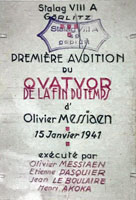
Chamber music, sometimes described as “the music of friends,” is generally used to refer to music composed for a small group of instruments or voices, with one performer to a part. The intimacy of chamber music makes it a perfect genre for compositions marking important events or for unusual combinations of instruments. This April, the Daily Classical Music Post will introduce you to some of these very special works.
Messiaen: Quatuor pour la fin du temps – 1. Liturgie de cristal
The French composer and ornithologist Olivier Messiaen (1908–1992) composed Quatuor pour la fin du temps (”Quartet for the end of time”) while he was in a prisoner of war camp during World War II. There were three other professional musicians in the camp with him, and he wrote this for them—an unusual combination of violin, cello, and clarinet—with a piano part that he would play. One of the German officers in the camp managed to get some manuscript paper for Messiaen, and he also made it possible for the composer to work in privacy in an isolated barracks.
In the Preface to the piece, Messiaen said that he was inspired by the following text from the Book of Revelation: “And I saw another mighty angel come down from heaven, clothed with a cloud: and a rainbow was upon his head, and his face was as it were the sun, and his feet as pillars of fire . . . and he set his right foot upon the sea, and his left foot on the earth. . . . And the angel which I saw stand upon the sea and upon the earth lifted up his hand to heaven, and sware by him that liveth for ever and ever . . . that there should be time no longer: But in the days of the voice of the seventh angel, when he shall begin to sound, the mystery of God should be finished . . .”
Quatuor pour la fin du temps is in eight movements. Many of the movements include some of Messiaen’s characteristic bird song. The eight movements are as follows: I. “Liturgie de cristal,” for the full quartet; II. “Vocalise, pour l’Ange qui annonce la fin du temps,” for the full quartet; III. “Abîme des oiseaux,” for solo clarinet; IV. “Intermède,” for violin, cello, and clarinet; V. “Louange à l’Éternité de Jésus,” for cello and piano; VI. “Danse de la fureur, pour les sept trompettes,” for the full quartet; VII. “Fouillis d’arcs-en-ciel, pour l’Ange qui annonce la fin du temps,” for the full quartet; and VIII. “Louange à l’Immortalité de Jésus,” for violin and piano.
Quatuor pour la fin du temps received its premiere in the camp on 15 January 1941. Peter Gutmann said, “Sadly, even modern program annotators still perpetuate myths asserted by the composer himself: a crowd of 5,000 jammed into the theater, the cello had only three strings, the clarinet was missing a key and the piano keys all stuck. Rebecca Rischin documented that, while the venue was bitter cold and dimly lit, the ‘theater’ was a partly-converted barracks that could have held at most a few hundred, and that others had no recall of damaged instruments (with which in any event the score could not possibly have been played). . . . Despite Messiaen’s penchant for exaggeration (which Rischin attributes to his desire to stress how far he transcended the challenging circumstances), it’s hard to doubt his oft-cited ultimate recollection: ‘Never have I been heard with as much attention and understanding’.”
My classical music post for today is Olivier Messiaen’s Quatuor pour la fin du temps, I. Liturgie de cristal.


Leave a Reply