

The entertainment industry loves biopics. It doesn’t really matter if the details are exaggerated or just plain untrue: all that matters is telling a good story! Biopics about classical music composers and musicians can range from the mostly factual to out-and-out fanciful. This March, the Daily Classical Music Post looked at some of these films. There are so many more; perhaps I’ll do another month on biopics in the future!
P.Tchaikovsky. Symphony № 5, Movement 1
How did we get to the end of March already? There are so many biopics that I wanted to include, but here we are with just one more to explore. And it’s a great one!
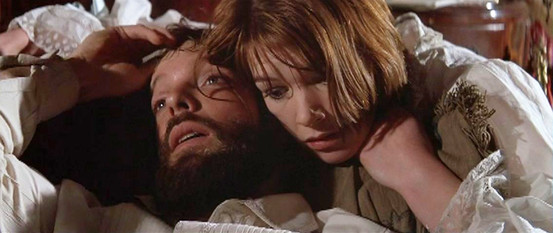
We’ve looked at several classical music biopics directed by Ken Russell, and they range from the really quite wonderful to the completely outlandish. I’d say that Russell’s The Music Lovers (1971), with a screenplay by Melvyn Bragg and starring Richard Chamberlain as the Russian composer Pyotr Ilyich Tchaikovsky (1840–1893), falls pretty close to the top of the outlandish side of the scale. I think Russell’s statement about getting backing for the film pretty much explains it all: “If I hadn’t told United Artists that it was a story about a homosexual who fell in love with a nymphomaniac it might have never been financed.”
Glenda Jackson was cast as Tchaikovsky’s wife, and Russell initially wanted Alan Bates to portray the composer (as Jackson and Bates had worked so well together in his Women in Love). Bates declined, as he said that he didn’t want to be typecast in sexual deviant roles. Chamberlain, basically known as the TV heartthrob Dr Kildare at that time, was not immediately favoured for the role by Russell, but when it was made known that Chamberlain was actually an accomplished pianist, he was all in.
I wouldn’t say that there is really a “plot” per se; there is hardly any dialogue, just a lot of flashbacks, nightmares, and fantasy sequences. Bragg purportedly based his script on letters written by Tchaikovsky. Russell saw Tchaikovsky as someone who could not love anyone other than himself and his sister, even though he wrote some of history’s most beautiful music.
The piano music in the film was dubbed by the Spanish pianist Rafael Orozco. There are excerpts from a lot of Tchaikovsky’s music, including Symphonies No 4, 5, and 6; 1812 Overture; Romeo and Juliet; the opera Eugene Onegin; and the Piano Concerto in b-flat minor, played by the London Symphony Orchestra conducted by André Previn.
Vincent Canby’s review pretty much says it all: “Richard Chamberlain . . . is fine as Tchaikovsky, looking a bit like a haunted faun, and Glenda Jackson is all sinewy nerves as Nina, but they are hard put to match the . . . nonstop hysteria of the production that surrounds them . . . I expect many people may look on The Music Lovers as an advance on the classical musical biographies turned out by Hollywood in the 1940s, but for all of its so-called frankness, there isn’t much difference between this kind of sensational, souped-up popularization and the sort of pious, souped-down popularization that cast Cornel Wilde as Chopin and Robert Walker as Brahms” (and as we discussed both of those films, you will understand what he means!). Toni Mastroianni said, “The movies have treated composers notoriously badly but few films have been quite so awful as this pseudo-biography of Tchaikovsky.” And Stefan Kanfer said, “No matter how miserable his actual life, the classical composer tends to suffer in a new way on film.” I think this is a perfect way to end our month on classical music biopics.
My classical music post for today is Pyotr Ilyich Tchaikovsky’s Symphony No 5: Movement 1.


Leave a Reply