

The medieval music theorist Guido d’Arezzo developed the four-line music staff—the precursor to the five-line staff—in or around the year 1024. Western art music notation as we know it today would not exist were it not for this revolutionary change. This February, the Daily Classical Music Post has explored music that used interesting, unusual, and innovative music notation.
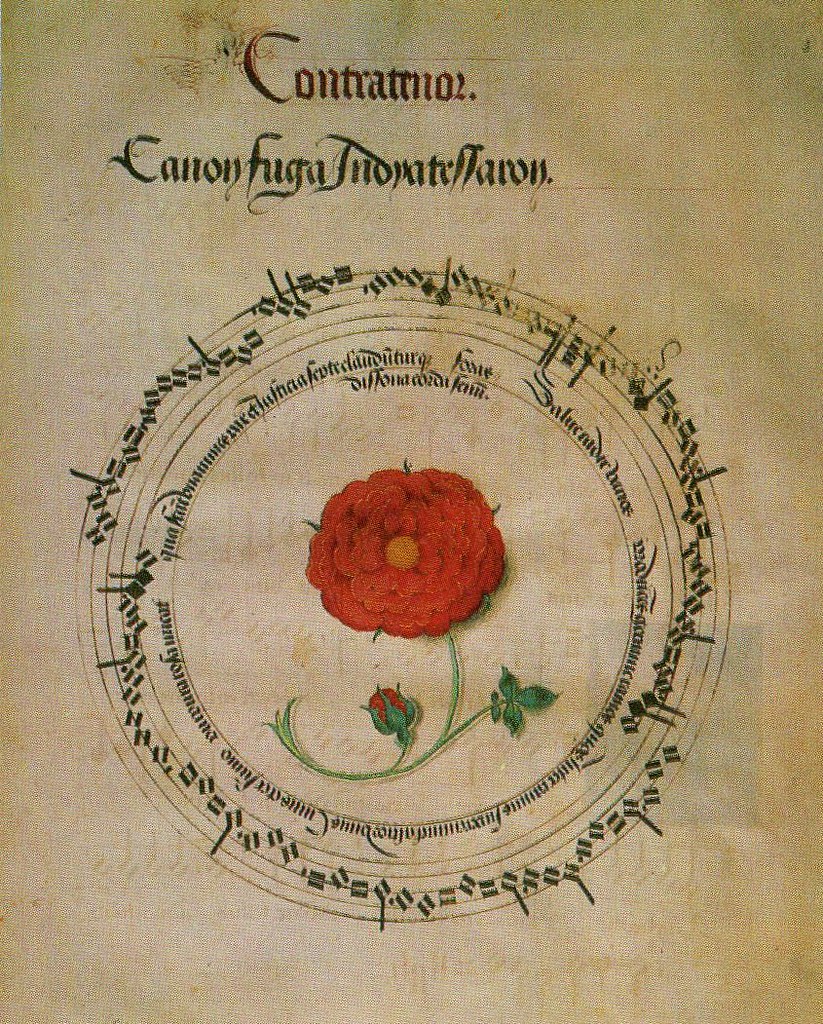
Richard Sampson: Double Circle Canon, “Salve Radix” (MANUSCRIPT ANIMATION)
The marriage of Catherine of Aragon to King Henry VIII was a (mostly) happy event, and many composers wrote music to celebrate it. One composer, Richard Sampson (c. 1470–1554) was a diplomat, clergyman (he eventually became Bishop of Chichester), and musician. His motet, “Salve Radix,” is a canon for bassus and countertenor (two singers on each part), set a fourth apart. It was the first piece in the volume that was presented to the king and his new wife.
The manuscript was written in a circle, reflecting the fact that the music is a canon, and in the centre of the circle there is a red rose, which was the heraldic badge of the House of Lancaster, from which Catherine was descended, entwined with the multiflowered plant that represents Henry’s Tudor dynasty.
Theodor Dumitrescu said, “Musically, the composition belongs to a tradition of four-voice double-canon writing cultivated largely in the first decades of the 16th century. Although the double-canons at the upper fourth are so restricted in terms of contrapuntal options that they all necessarily share a considerable amount of musical material, Salve radix exhibits a close relationship in particular to Josquin’s En lombre dung buysonnet. The near-duplication of multi-measure passages of the latter work in Salve radix, as well as the absorption of brief melodic figures and restrictions (e.g., the lower voices change pitch breve-by-breve), indicates that this is a case of deliberate musical modeling.”
My classical music post for today is Richard Sampson’s “Salve Radix.”


Leave a Reply