

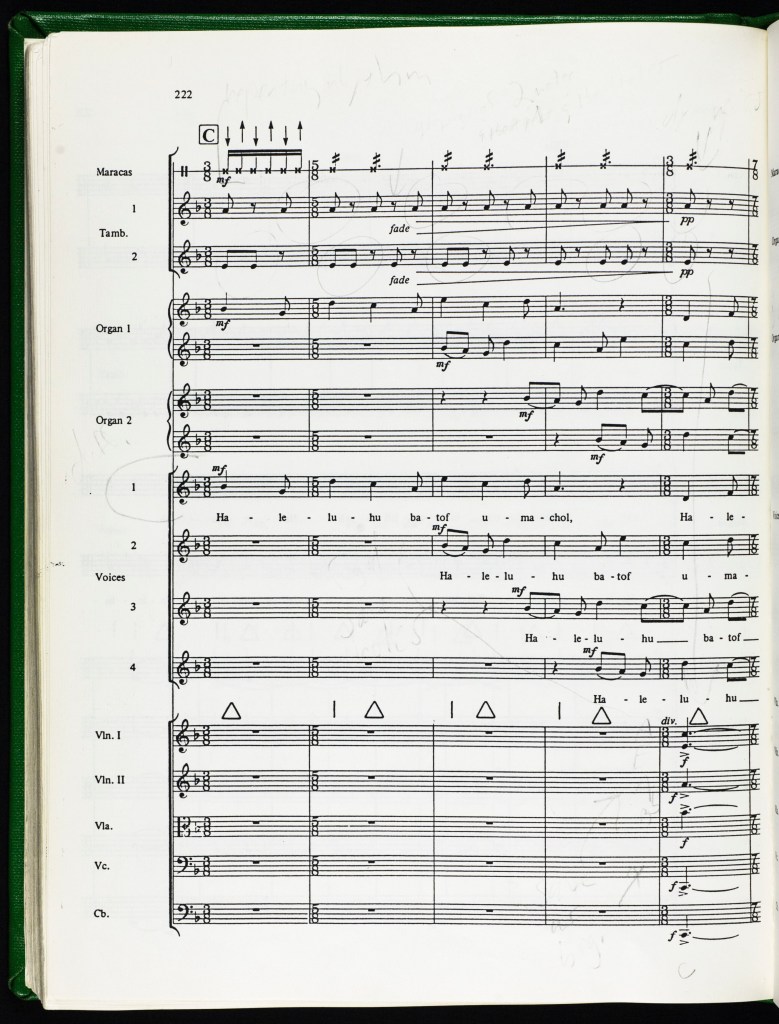
The medieval music theorist Guido d’Arezzo developed the four-line music staff—the precursor to the five-line staff—in or around the year 1024. Western art music notation as we know it today would not exist were it not for this revolutionary change. This February, the Daily Classical Music Post will explore music using interesting, unusual, and innovative music notation.
Reich – Tehillim – Complete (Official Score Video)
Hebrew cantillation, a sophisticated form of mnemonic music notation, is one of the very few systems like this that has an unbroken chain dating back to the medieval period. Preservation of a mnemonic system depends entirely on transmission from person to person. In Hebrew cantillation, also called trope, different marks indicate notes, stress, musical value, and punctuation. These signs help the reader determine which chant to apply to the readings. (This is a very simplified description.)
The American minimalist composer Steve Reich (born 1936) studied cantillation with a cantor in New York City after rediscovering his Jewish roots. He became fascinated with it and wanted to somehow incorporate it into his music; he said, “I found it . . . inappropriate to imitate the sound of Hebrew cantillation. It is true that I am Jewish, but I did not grow up with the sound of cantillation and really discovered it in my late 30s. . . . [I]t seems to me far more fruitful and certainly more substantial to try and understand the structure of Hebrew cantillation and apply that to the pitches and timbres one has grown up with so as to hopefully create something new.”
Tehillim, settings of some excerpts from the Book of Psalms, was composed in 1981. Reich chose the Psalms for his text because, as he said, “One of the reasons I chose to set Psalms as opposed to parts of the Torah or Prophets is that the oral tradition among Jews in the West for the singing of the Psalms has been lost. (It has been maintained by Yemenite Jews.) This means that I was free to compose the melodies for Tehillim without a living oral tradition either to imitate or to ignore.” In this work, Reich uses the syntax of the Hebrew words to determine the melody and the rhythm, which makes it an interesting 20th-century take on cantillation. He uses symbols throughout the score to indicate inflection, rhythm, and emphasis.
Steve Schwartz said, “Tehillim begins with a joyful noise that just about bypasses the brain altogether and heads directly for the feet. If you can keep your feet from tapping or your fingers from snapping, you probably can also eat just one potato chip.”
My classical music post for today is Steve Reich’s Tehillim.


Leave a Reply