

The medieval music theorist Guido d’Arezzo developed the four-line music staff—the precursor to the five-line staff—in or around the year 1024. Western art music notation as we know it today would not exist were it not for this revolutionary change. This February, the Daily Classical Music Post will explore music using interesting, unusual, and innovative music notation.
Tōru Takemitsu (1930–1996) was a Japanese composer and writer on aesthetics and music theory. He was extremely subtle in his manipulation of instrumental and orchestral timbre. He was influenced by jazz, popular music, avant-garde music, and traditional Japanese music, and his music also brings to mind the 20th-century French composers Claude Debussy and Olivier Messiaen. In the 1960s, his music was based to a large degree on John Cage (particularly in the use of indeterminate procedures and graphic-score notation).
In 1967, Takemitsu wrote November Steps for biwa (a Japanese fretted lute), shakuhachi (a Japanese end-blown flute), and Western orchestra. Initially, Takemitsu had great difficulty uniting these instruments from such different musical cultures into one work. In 1973, Takemitsu returned to the instrumental combination of shakuhachi, biwa, and orchestra, in the less-well-known Autumn. He was able to integrate the traditional Japanese instruments and the orchestra much more in this work; in November Steps, the two contrasting instrumental ensembles alternate, with only a few moments of contact. Takemitsu expressed this change in attitude: “But now my attitude is getting to be a little different, I think. Now my concern is mostly to find out what there is in common. . . . Autumn was written after November Steps. I really wanted to do something which I hadn’t done in November Steps, not to blend the instruments, but to integrate them.”
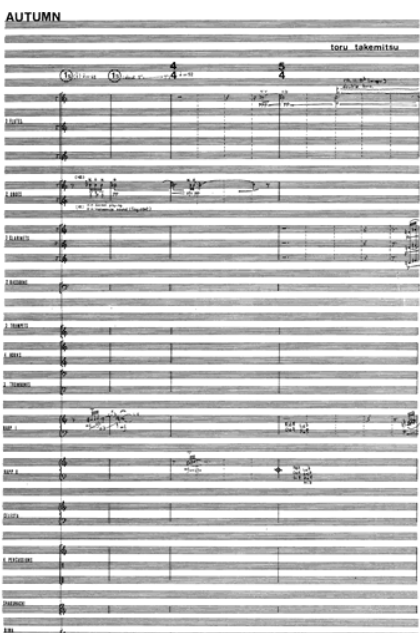
Takemitsu transcribed the notation for the traditional Japanese instruments into Western notation in his manuscript score, but he also used graphics to indicate certain techniques that the performers would employ. Autumn is a fascinating soundscape of different timbres and sonorities, and Takemitsu’s brilliance at melding the traditional Japanese instruments with a classical Western orchestra is obvious throughout.
My classical music post for today is Tōru Takemitsu’s Autumn.


Leave a Reply