

The medieval music theorist Guido d’Arezzo developed the four-line music staff—the precursor to the five-line staff—in or around the year 1024. Western art music notation as we know it today would not exist were it not for this revolutionary change. This February, the Daily Classical Music Post will explore music using interesting, unusual, and innovative music notation.
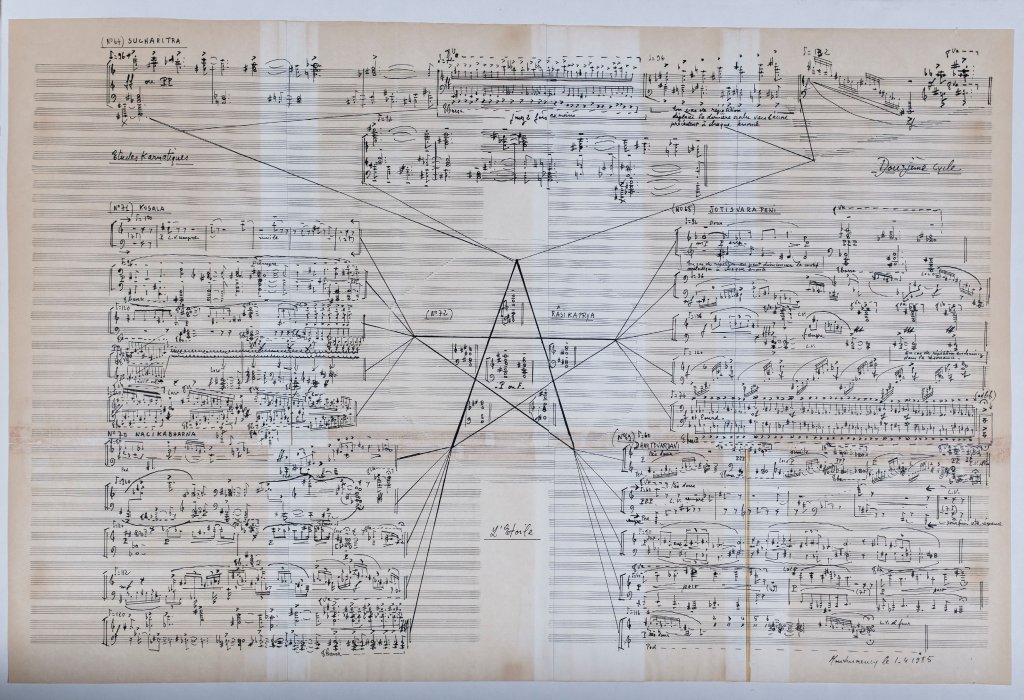
Jacques Charpentier, 72 Études karnatiques, for piano (1957–84)
The French composer Jacques Charpentier (1933–2017) spent two years in India, experimenting with a way to incorporate Western classical music styles into classical Indian music forms. It took him nearly 30 years to compose the monumental 72 Études Karnatiques for piano, which was the result of this experiment. Charpentier dedicated the work to Olivier Messiaen, who had been his teacher.
Giusy Caruso said, “Firstly propounded in 1550 by Raamamaatya and, then, structured in the 17th century by Ventakamakhi, Carnatic music is a musical tradition from South India, based on 72 fixed scales (ragas), which constitute the so-called Melakartha system. Each scale presents the octave divided into two equal tetrachords, a group of four notes, where the first tetrachord is fixed and the second is restructured by following the twelve chromatic degrees.”
Charpentier found the Carnatic modes transcribed into Western musical notation in a Parisian conservatory library, and he used this as a starting point for the 12 cycles that make up the 72 Etudes Karnatiques. Each cycle is related to the Vedic divinities. Cycle 12 is dedicated to Aditya, the 12 sun divinities in the cosmic universe. The 72nd étude was written in the form of a star; Caruso said, “The performer has to play the five chords, located in the five spikes of the Star, using her own combination related to the different phrases written by the composer in each etude of this cycle. By leaving the interpreter free to perform all the sections of these last six etudes, Charpentier approaches a form of improvisation as in an Indian performance.”
The link in today’s post will take you directly to Cycle 12, but the rest of this epic work is available there if you want to listen to the entire piece.
My classical music post for today is Jacques Charpentier’s 72 Études Karnatiques: Cycle 12.


Leave a Reply