

The medieval music theorist Guido d’Arezzo developed the four-line music staff—the precursor to the five-line staff—in or around the year 1024. Western art music notation as we know it today would not exist were it not for this revolutionary change. This February, the Daily Classical Music Post will explore music using interesting, unusual, and innovative music notation.
Telemann – Intrada-Suite for 2 Violins ‘Gulliver’s Travels’
Jonathan Swift published his satirical novel Gulliver’s Travels in 1726, and the German Baroque composer Georg Philipp Telemann (1681–1767) immediately realised that he could hitch a ride on Swift’s coattails. Within two years, Telemann had composed his Intrada-Suite (also known as the “Gulliver Suite”), and it was an immediate success.
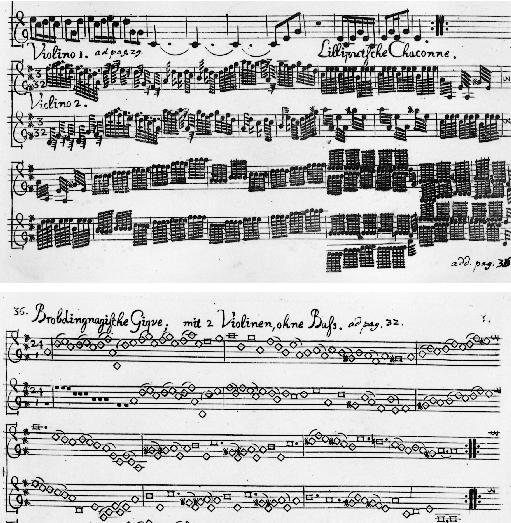
Francis Humphrys said, “[Telemann] cleverly published this in his monthly magazine, Die getreue Musik-Meister, one movement at a time, enticing his followers to keep coming back for more, thus ensuring constant revenue from the paper. The Suite opens with a noble Intrada, followed by a flitting Chaconne to represent the Lilliputians, which is written in 3/32 time in a visually apt score of barely legible, tiny notes, of which only the performers are aware. Similarly, the following movement representing the Brobdignagian giants is presented in 24/1 time, making heaving weather out of the so called gigue. The Laputians are represented by a dreamy theme, occasionally interrupted by their characterised rattle-like flappers, which just for a moment knock them out of their lethargic arts-obsessed state. A comparative duet follows, the violins each portraying the very different characters of the Houyhnhms and the Yahoos, the uplifting, but stubborn serenade holding its own against the chaotic dance in this delightful conclusion to the musical narrative.”
This frankly somewhat bizarre and really humourous suite has been transcribed for many different instruments over the years, as it is a real crowd-pleaser and also fun for the performers, who are in on the musical notation joke even if the audience is not.
My classical music post for today is Georg Philipp Telemann’s Intrada-Suite.


Leave a Reply