

The medieval music theorist Guido d’Arezzo developed the four-line music staff—the precursor to the five-line staff—in or around the year 1024. Western art music notation as we know it today would not exist were it not for this revolutionary change. This February, the Daily Classical Music Post will explore music using interesting, unusual, and innovative music notation.
John Bull – Sphera Mundi – Bob van Asperen
Not much is known about the early life of the English composer John Bull (1562/3–1628), but what is certain is that he was one of the most famous composers of keyboard music in the early 17th century. He also composed many verse anthems, canons, and other choral works. Some people think that he was the composer of the music for “God Save The King,” but that has never been definitively proved.
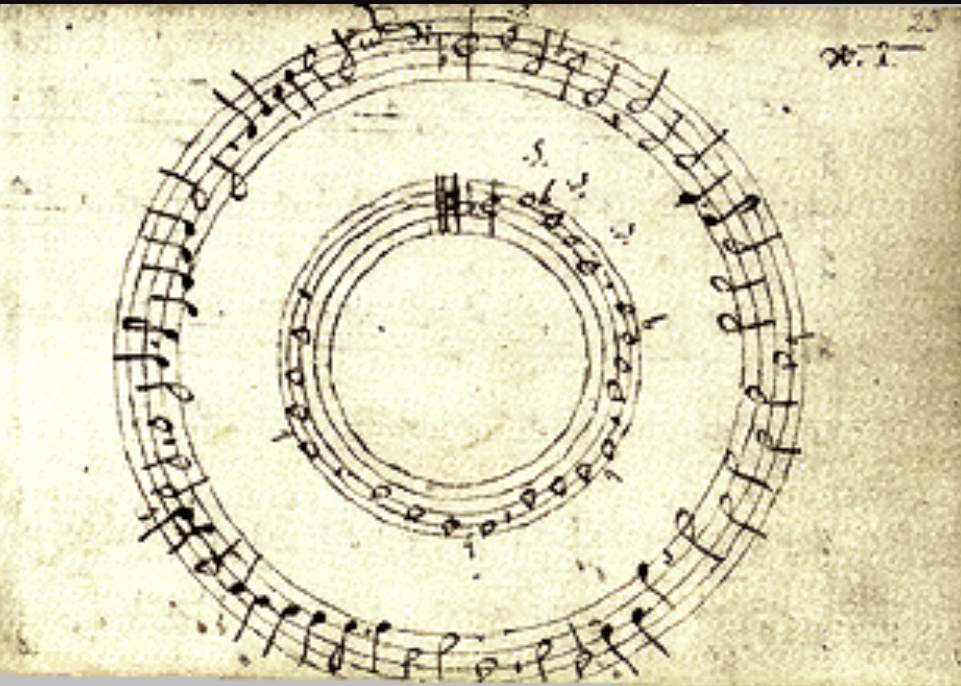
René Descartes made a circle wheel diagram of a tempered diatonic octave in 1618. He wanted to create an arrangement of just ratios, dividing a single octave around the circumference of a circle. Bull knew of Descartes’ diagram, and he based his six-part puzzle canon Sphera mundi to some extent on it. The music is also a canon on the Miserere chant; it was common at that time for composers to use Gregorian chant as a basis for their compositions, and Bull actually quoted the Miserere chant in more than one work.
The manuscript of Sphera mundi is in a circle, a joke on the fact that the canon was actually a round. Niels Hutchison said, “In 1621, John Bull formed a double round-canon into circles, to echo the cyclic form of the music and represent the heavenly and earthly spheres suggested by its title. The musical score contains a whole melody, rather than Descartes’ single octave.”
Sphera mundi is a perfect example of “eye music,” that is, “musical notation with a symbolic meaning that is apparent to the eye but not to the ear” (per Robert Thurston Dart). As you listen to this piece composed for the virginals, you can appreciate the canon, but if you know that the manuscript was written in circles, you get the inside joke as well.
My classical music post for today is John Bull’s Sphera mundi.


Leave a Reply