

The medieval music theorist Guido d’Arezzo developed the four-line music staff—the precursor to the five-line staff—in or around the year 1024. Western art music notation as we know it today would not exist were it not for this revolutionary change. This February, the Daily Classical Music Post will explore music using interesting, unusual, and innovative music notation.
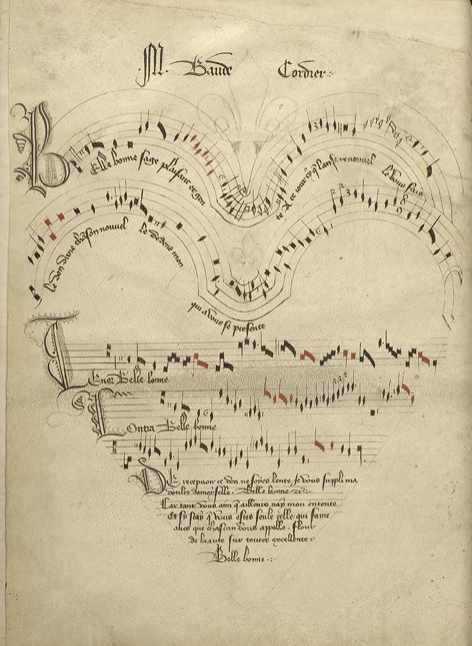
Baude Cordier: Rondeau upon a Heart, “Belle Bone Sage” (MANUSCRIPT ANIMATION)
The French ars subtilior composer Baude Cordier (fl. early 15th century) is an enigma. He may have been a musician in the court of Philip the Bold, but recent scholarship has rejected this. In any event, he is known for his experimental musical notation, which often was written in a shape related to the subject of the piece. His unique style influenced many composers in his lifetime and well into the 20th century (including Karlheinz Stockhausen).
The ars subtilior was a musical style that was extremely complex rhythmically and notationally. Most of the music is secular, and some composers, including Cordier, delighted in hidden meanings, puns, and jokes. Jacob Senleches wrote La Harpe de melodie in the shape of a harp; Cordier’s output includes a canon called Tout par compas that is written on a circular staff and today’s lovely chanson, “Belle, Bonne, Sage,” written in the shape of a heart.
This score also is a great example of red note notation (also called coloration), which indicates adjustments in rhythm. “Belle, Bonne, Sage” was published in the Chantilly Codex, a medieval manuscript dating from the late 14th century. Cordier’s pieces were added later, at the front of the volume. This work is one of the earliest examples of “eye music.”
I obviously missed an opportunity; I should have posted this on the 14th! But no matter; we can enjoy this delightful work today.
My classical music post for today is Baude Cordier’s “Belle, Bonne, Sage.”


Leave a Reply