

The medieval music theorist Guido d’Arezzo developed the four-line music staff—the precursor to the five-line staff—in or around the year 1024. Western art music notation as we know it today would not exist were it not for this revolutionary change. This February, the Daily Classical Music Post will explore music using interesting, unusual, and innovative music notation.
The avant-garde Greek-French composer Iannis Xenakis (1922–2001) was well known for integrating architecture (he actually worked as an architect in Paris) and music; most of his compositions take into account where they would be performed. He also was one of the first composers to use mathematical models including set theory, stochastic processes, and game theory in his works. Many scholars see his innovations as the precursor to the development of electroacoustic music in the latter part of the 20th century.
Xenakis composed Pithoprakta in 1956. He made up the title; it basically means “actions through probability.” Like many of his compositions, it is, as one reviewer wrote, “impenetrable to many listeners, and a good number of those folks would describe it as ‘unlistenable’ as well.” To many musicians, however, his output is fascinating and influential.
Stephen David Beck said, “Pithoprakta is an example of a stochastic work. . . . Pithoprakta, composed in 1955, is for 49 musicians—2 trombones, xylophone/woodblock, and 46 strings—where each instrument is conceived as an independent molecule following the Maxwell-Boltzmann distribution law.”
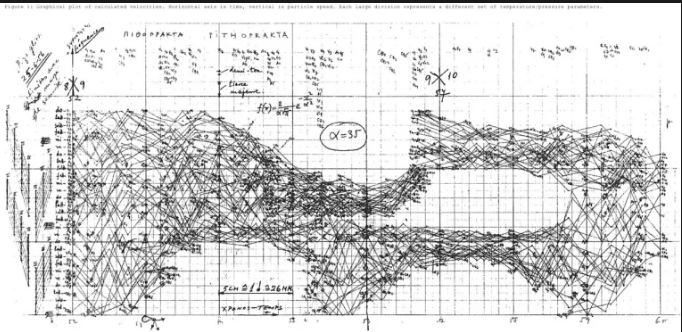
As you can see in the image in today’s DCMP, Xenakis first graphed his calculations, and then he connected the measurements to show the changes in velocity over time. He then took this graph and transcribed it into standard Western musical notation, with squares in the graph representing intervals and bar lines. The result is an early example of sonification. As Beck pointed out, although Xenakis used a specific process for determining the notes in the work, there is no one specific answer. Therefore, “Pithoprakta bridges the gap between deterministic music and indeterminate ‘chance’ music.”
My classical music post for today is Iannis Xenakis’ Pithoprakta.


Leave a Reply