

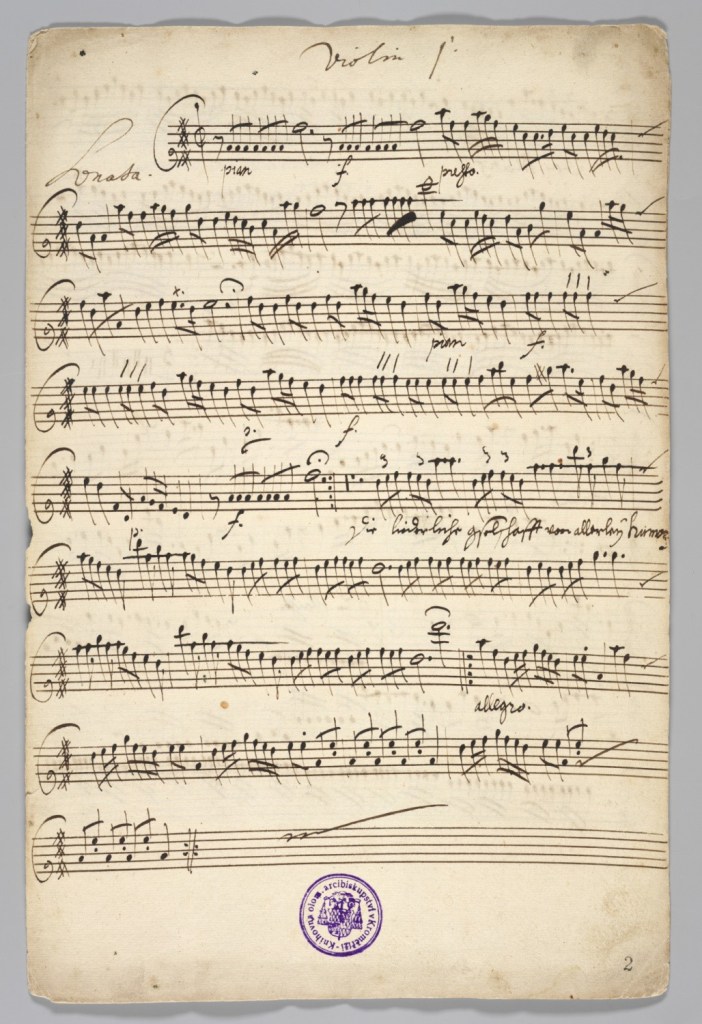
The medieval music theorist Guido d’Arezzo developed the four-line music staff—the precursor to the five-line staff—in or around the year 1024. Western art music notation as we know it today would not exist were it not for this revolutionary change. This February, the Daily Classical Music Post will explore music using interesting, unusual, and innovative music notation.
Heinrich Biber – Battalia à 10 (1673)
Move over, Charles Ives, Heinrich Ignaz Franz Biber (1644–1704) perfected the art of cacophony long before you had a go!
On the title page of Biber’s manuscript there is a rudimentary indication and explanation of what one of his markings meant; he had different specific directions for the extended string techniques that he required in some of the movements, including striking strings with the wood of the bow, threading paper between strings to make a rattling sound similar to that of a snare drum, and snap pizzicato. It wasn’t until well into the 20th century that other composers experimented with these types of techniques.
Kivie Cahn-Lipman said, “Perhaps the most famous surviving work of baroque battle music is . . . composed by H. I. F. von Biber, an Austrian composer who worked in Graz and Kroměříž before settling in Salzburg. Biber’s Battalia (1673) is in eight continuous movements and dedicated to the god Bacchus. A brief untitled introduction is followed by Die liederliche gesellschaft von allerley Humor (the dissolute company of all sorts of humor), in which eight contemporaneous folk songs are heard simultaneously in different keys, and a note in the manuscript reads: ‘hic dissonat ubique nam ebrii sic diversis Cantilenis clamare solent’ (here is dissonant everywhere as drunks shout out various songs). This cacophony is followed by two untitled presto movements, with Der Mars (the god of war) between them. A gentle aria is a respite but segues directly into Die Schlacht (the battle). Battalia ends with an Adagio: Lamento der verwundten Musquetir (lament of the wounded musketeer).
The second movement of the piece is pretty wild, and is quite reminiscent of Ives’s Fourth of July. There are eight different parts playing simultaneously, in different key signatures and time signatures. The folk songs represent different countries and regions of Europe, and include songs from Slovakia, Bohemian, Italy, Austria and Hungary, and Styria.
My classical music post for today is Heinrich Biber’s Battalia.


Leave a Reply