

The medieval music theorist Guido d’Arezzo developed the four-line music staff—the precursor to the five-line staff—in or around the year 1024. Western art music notation as we know it today would not exist were it not for this revolutionary change. This February, the Daily Classical Music Post will explore music using interesting, unusual, and innovative music notation.
I can remember exactly where I was when I first heard Stimmung by the German composer Karlheinz Stockhausen (1928–2007). I had never listened to anything quite like it, and I was absolutely blown away. I’m really not joking when I say that my life was never the same after.
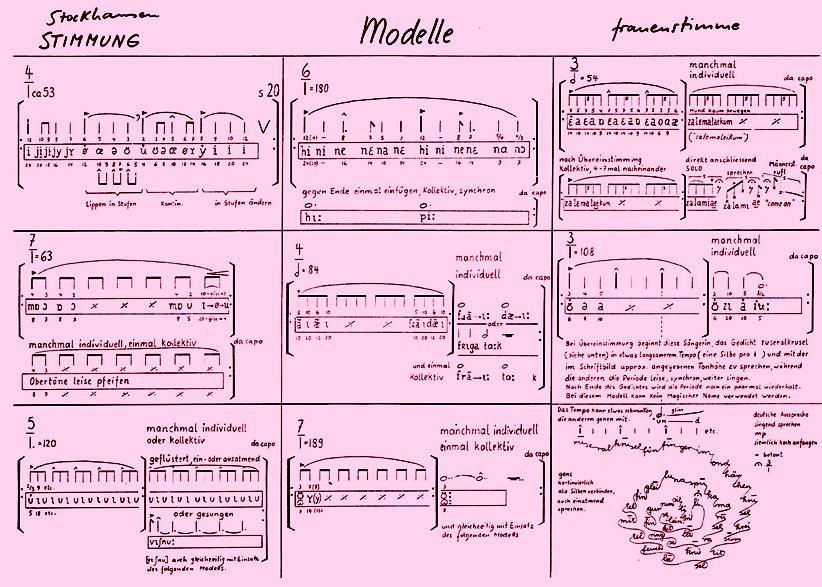
I’m going to quote Ed Chang here, as there is so much to say about the work, and he says it really well: “STIMMUNG is in its simplest explanation a sequence of 51 different vowel-based vocal patterns (without pitch) which are interspersed with ‘Magic Names’ and interrupted 3 times by passages of erotic poetry. Each vocal pattern (‘Model’) is started by an indicated vocalist and the other vocalists gradually transform whatever they are doing to match the new Model. . . . STIMMUNG was commissioned by a traditional vocal group accustomed to performing madrigals and things like that, but when Stockhausen found himself unable to sing melodies out loud at his home (due to his sleeping newborn child Simon) he began humming. From humming with his skull against the wall (and hearing Simon’s own humming from his crib) he became interested in composing for overtones on a static chord. Additionally, he had just returned from a few weeks exploring the ruins of the Mayas in Mexico and was inspired by the stark but iconic architecture he found there, as well as the accounts of the ancient (and sometimes bloody) rituals conducted in those places.”
Today’s image is of a page containing nine models from which the female singers can choose their pitches and shapes. The entire score is a mix of somewhat recognisable musical notation, graphical representations, and elaborate text. The Models are intoned on six notes from a B-flat Major 9th chord, and some of the text is spoken. I’ve shared the playlist of the Paul Hillier Theatre of Voices recording so you can listen to sections if you’d prefer, as this is quite a lot to take in at one time!
My classical music post for today is Karlheinz Stockhausen’s Stimmung.


Leave a Reply